

Editor : See pictures on the National Geographic website
Researchers have discovered evidence of an ancient sea creature that would have made Tyrannosaurus rex, think twice before stepping into the ocean.

| Biology | November 10, 2005 10:27 PM |
Editor : See pictures on the National Geographic website
Researchers have discovered evidence of an ancient sea creature that would have made Tyrannosaurus rex, think twice before stepping into the ocean.
| Full story | 0 Comments | 6687 views |
| Biology | November 10, 2005 10:26 PM |
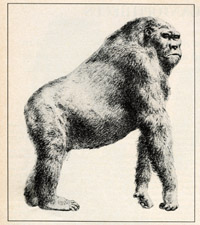
Gigantopithecus blackii, the largest primate that ever lived.A gigantic ape, measuring about 10 feet tall and weighing up to 1,200 pounds, co-existed alongside humans, a geochronologist at McMaster University has discovered.
| Full story | 2 Comments | 6741 views |
| Biology | November 10, 2005 10:26 PM |
Arizona State University geochemist Lynda Williams and her colleagues have discovered that certain clay minerals under conditions at the bottom of the ocean may have acted as incubators for the first organic molecules on Earth.
| Full story | 0 Comments | 7181 views |

| Microbiology | November 10, 2005 10:26 PM |
The biologist Alejandro Toledo Arana has identified two new genes that operate as regulators in the formation process of the biofilm of Staphylococcus aureus, one of the bacteria most frequently involved in infections following medical implants, and has explained the functioning of a structural protein involved in this process. His research was the subject of a PhD thesis recently defended at the Institute of Agribiotechnology, a joint CSIC and Public University of Navarra centre, and is an advance in the race to identify action targets for the development of pharmaceutical drugs to combat these infections.
| Full story | 0 Comments | 5900 views |
| Biology | November 10, 2005 10:26 PM |
Howard Hughes Medical Institute researchers have discovered that pheromones essential for mating behavior in mice are recognized by the nose and not by the vomeronasal system, as researchers had long suspected.The new studies demonstrate that the main olfactory epithelium, which was presumed to be mostly involved with the sense of smell, plays a critical role in pheromone detection.
| Full story | 0 Comments | 5283 views |

| Stem Cell Research | November 10, 2005 10:26 PM |
A single cell with the potential to repair damaged heart muscle tissue . . . regenerate injured bone . . . create new cartilage or skin . . . even reverse nerve damage. Human stem cells offer tremendous hope for the development of revolutionary medical treatments for these and a variety of other human health problems.
| Full story | 0 Comments | 6174 views |
| Biology | November 10, 2005 10:26 PM |
Howard Hughes Medical Institute researchers have discovered a vast network of neurons in the brain of mice that governs reproduction and controls the effects of reproductive status on other brain functions.
| Full story | 0 Comments | 6818 views |
| Microbiology | November 10, 2005 10:26 PM |
A University of Queensland study mapping the evolution of genes has shed light on the role of gene transfer in bacterial diseases.
| Full story | 0 Comments | 6677 views |

| Environment | November 10, 2005 10:26 PM |
A group of history students have discovered the antler of an Irish Elk in cliffs near Kirk Michael on the Isle of Man.
| Full story | 0 Comments | 5844 views |
| Biology | November 10, 2005 10:26 PM |
A leading neuroscientist at MIT and one from the University of California at San Francisco (UCSF) report in the Nov. 4 special issue of Science dedicated to the brain that the controversy is over: The "protomap" and "protocortex" theories of brain development are dead.
| Full story | 0 Comments | 7013 views |
