
Biology News Net
RSS 2.0 Feed
Biology
BiologySeptember 14, 2005 09:29 PM

uot0913_2sm.jpg
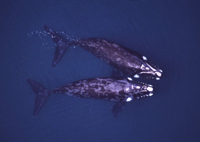
An aerial photograph of two right whales in the Atlantic Ocean offshore from Argentina shows the distinctive white markings created by small crustaceans -- known as cyamids or 'whale lice' -- that attach themselves to callus-like material on the whales' heads. University of Utah researchers learned about the evolution of different species of right whales by studying the genes of the 'whale lice' that ride the whales.
Credit: Roger Payne, Ocean Alliance/Whale Conservation Institute.
University of Utah biologists studied the genetics of "whale lice" – small crustaceans that are parasites on endangered "right whales" – and showed the giant whales split into three species 5 million to 6 million years ago, and that all three species probably were equally abundant before whaling reduced their numbers.

The five-year study, published in the October 2005 issue of the journal Molecular Ecology, is the first in which the genes of whale lice were used to track the genetic evolution of whales. They are not true lice, but instead are tiny crustaceans named cyamids. The harmless parasites ride the whales their entire lives, so their evolution reflects the evolution of the whales.

Environment

Editor : Be sure to check out all the satellite images showing areas of deforestation on the NASA website

The Amazon, a vast tropical forest stretching across South America, is so large that if you were to take pictures of the region with optical photographs, it would take about ten years to get a composite image of the area. To make matters worse, its landscape is constantly evolving. So, scientists have learned to seek answers about this fragile ecosystem with the help of powerful eyes above - satellites.

Environment

Today, scientists estimate that between one-third and one-half of our planet's land surfaces have been transformed by human development.

Biology
BiologySeptember 14, 2005 08:27 PM

Restoring the rich diversity of trees that once characterized expansive tracts of tropical rainforest gets a helping hand from native birds and bats. Just how big a role these winged gardeners play is a question ecologists from the University of Illinois at Chicago and several Latin American universities are about to find out by setting up essentially a living laboratory in Mexico's gulf coast state of Veracruz.

Microbiology

In the wake of Katrina, the public health threats from infectious diseases in hurricane-devastated areas are more likely to come from milder, more common infections rather than exotic diseases. These common infections can often be prevented using simple hygiene measures and a little common sense.

Microbiology

In findings with implications for pandemic influenza, a new study reports for the first time that a less-virulent strain of avian influenza virus can spread from poultry to humans. The research appears in the October 1 issue of The Journal of Infectious Diseases, now available online.

General
GeneralSeptember 14, 2005 05:46 PM

Not much going on today (it was one of those days, you know?), and I gotta get vaccinated for my workshop in Mexico later tonight. Plenty of fun!

- Primordial soup where life began on earth was hot and not cold
- Researchers Pinpoint Source of Poison Frogs' Deadly Defenses
- Millions of bacterial species revealed underfoot
- Scientists probe anti-ageing gene
- Researchers Find That Carbon Dioxide Does Not Boost Forest Growth
- 'Worst seabird season on record'

3 Comments 6571 views