
Biology News Net
RSS 2.0 Feed
General
GeneralSeptember 12, 2005 08:29 PM

Yet another redesign of the site (I love to play with CSS, it's really not my fault!), I hope you guys/girls love it! As usual, feel free to leave comments or report bugs via the forum, comments system or contact info at the bottom of the page. I'm quite busy preparing for a poster for a workshop in Mexico I'll be attending to in October. Should be fun!

- Crystal clumps preserve fossilised DNA
- Chimps killed after zoo escape
- Polymer breakthrough to boost smart drugs
- Declaration signed on great apes
- Aquarium animals to be airlifted out of New Orleans
- Vaccine shortage may pose risk for Katrina survivors
- Concern over three-parent embryo
- Flying reptiles just got bigger
- Ancient humans altered climate

0 Comments 6522 views
Biology

gtech091205_1sm.jpg
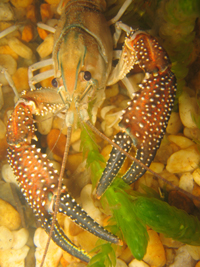
A crayfish dines on an exotic delicacy of Egeria densa
Here's a test. Take a crayfish, offer it two meals - one the native plants that it eats everyday, the other a gourmet meal of a similar, but exotic species of plant. Conventional biological wisdom predicts it will stick with the tried and true. But new research at the Georgia Institute of Technology suggests that plant eaters may be more adventurous than previously thought and prefer to nosh on exotic meals by a ratio of three to one. The findings, which appear in the September issue of Ecology Letters, could point the way to better strategies for controlling the billions of dollars in damage that invasive species cause every year.

Biology

Researchers at Yale School of Medicine have found that 85 percent of embryos transferred during in vitro fertilization fail to become live births, highlighting the need for improving diagnostic techniques to identify viable embryos.

Health & Medicine

Clioquinol, an antibiotic that was banned for internal use in the United States in 1971 but is still used in topical applications, appears to block the genetic action of Huntington's disease in mice and in cell culture, according to a study reported by San Francisco VA Medical Center (SFVAMC) researchers.

Health & Medicine

Study suggests chronic infections may create autoimmune response

New research finds the human immune system has foregone evolutionary changes that would allow it to produce better antibodies in less time because the improved antibodies would be far more likely to attack the body's own tissues. The Rice University study finds the immune system has evolved a near-perfect balance for producing antibodies that are both effective against pathogens and unlikely to cause autoimmune disease.

Microbiology

Four seemingly unrelated viral diseases may some day be defeated by a single treatment, according to a recent collaborative study involving researchers at the University of Georgia's College of Veterinary Medicine.

Molecular & Cell Biology

According to professor Thomas Kirkwood of the University of Newcastle, there is no single gene for ageing. Throughout time, Humans have used energy to get food, produce offspring and survive danger - not to repair and maintain cells. So the maintenance system in the body slowly breaks down.

Health & Medicine

More women choosing C-sections when no medical necessity exists - Florida, New York, New Jersey have highest rates;Nevada, Washington, Florida increase most

Molecular & Cell Biology

For the first time, researchers have observed exactly how some cells are able to repair DNA damage caused by the sun's ultraviolet (UV) radiation.