
Biology News Net
RSS 2.0 Feed
Biology
BiologyAugust 13, 2005 12:21 PM

tam0811_2.jpg
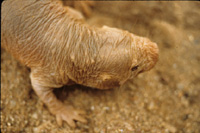
Only in the past 25 years have scientists learned of the strange lifestyle of African mole-rats. All 12 species live entirely underground. A few colonies of naked mole-rats, a social species of the family, have been raised for study purposes in a specially designed observation tunnels. (Texas Agricultural Experiment Station photo by Dr. Rodney Honeycutt)
This is all underground, and naked mole-rats prefer it that way: Momma naked mole-rat is the only one having babies, and she's got several naked mole-rat boyfriends.

Were it human, the family would argue it out on a national talk show. As it is, the social behavior of these tiny rodents has scientists intrigued, right down to their naked mole-rat molecules. "African mole-rats are very good models for studying social structure. I'm interested in the genetic markers associated with structure," said Colleen Ingram, whose doctoral degree will be bestowed Friday at Texas A&M University based on her findings about the critters' parentage.

Molecular & Cell Biology

Researchers at the Umeå Plant Science Centre at the Swedish University of Agricultural Sciences (SLU), Sweden, report about a breakthrough in our understanding of how plants control their flowering. In an article published in the international journal Science, Thursday 11th, they show how a small molecule that is formed in the plant leaves is transported to the shoot tips where it induces the formation of flowers. This knowledge can lead to the development of new tools that can be used to control the timing of plant flowering, something that is of central importance in both agriculture and forestry.

Biology

A Duke University study has found that maturing stands of pines exposed to the higher levels of carbon dioxide expected by mid-century produce more needles than those absorbing today's levels of the gas, even under drought conditions. However, the study also found that lack of soil nutrients may impose limitations in many forests.

Biology

Swarms of millions of locusts have, since Biblical times and until our very own day, been considered a "plague" of major proportions, with the creatures destroying every growing thing in their path.

Environment

The effect of the sun's heat on weather balloons largely accounts for a data discrepancy that has long contributed to a dispute over the existence of global warming, according to a report by scientists at Yale University and the National Oceanic and Atmospheric Administration (NOAA).

Molecular & Cell Biology

In findings that could lead to curing some forms of congenital blindness through gene therapy, researchers at UCLA have discovered that RPE65, a gene missing in infants born with the blinding disease Leber congenital amaurosis, is also a key enzyme in the visual cycle. The identity of this enzyme has long been a mystery to scientists.

Environment

Coastal populations and ecosystems are more likely to bounce back from extreme coastal disasters by protecting local environments and building on local knowledge, according to a report published in Science.