

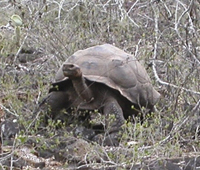
Unnamed taxon of Galapagos Tortoise Almost 150 years after Charles Darwin proposed a mechanism for biological evolution, previously unrecognized diversity has been discovered among the giant tortoises of the Galápagos, Geochelone nigra, whose distinctiveness was an inspiration in formulating the theory of natural selection.

| Biology | July 27, 2005 05:55 PM |
| Full story | 0 Comments | 10630 views |

| Stem Cell Research | July 27, 2005 05:54 PM |
Final results of a study conducted at Johns Hopkins show that stem cell therapy can be used effectively to treat heart attacks, or myocardial infarction, in pigs. In just two months, stem cells harvested from another pig's bone marrow and injected into the animal's damaged heart restored heart function and repaired damaged heart muscle by 50 percent to 75 percent.
| Full story | 0 Comments | 8747 views |

| Gene Therapy | July 27, 2005 05:53 PM |
Combining partially differentiated stem cells with gene therapy can promote the growth of new "insulation" around nerve fibers in the damaged spinal cords of rats, a new study shows. The treatment, which mimics the activity of two nerve growth factors, also improves the animals' motor function and electrical conduction from the brain to the leg muscles. The finding may eventually lead to new ways of treating spinal cord injury in humans. The study was funded in part by the National Institute of Neurological Disorders and Stroke (NINDS), part of the National Institutes of Health.
| Full story | 0 Comments | 10100 views |

| Bioinformatics | July 27, 2005 05:52 PM |
An innovative new statistical method, described in the open-access journal PLoS Biology, streamlines the computation required to identify all the potential locations in the genome that influence a particular physical trait, or phenotype. Thanks to the new method developed by John Storey, Joshua M. Akey, and Leonid Kruglyak, researchers have a more efficient genome-mining technique to help them identify all the genomic elements that produce specific traits.
| Full story | 0 Comments | 6514 views |

| Molecular & Cell Biology | July 27, 2005 05:50 PM |
Researchers at the University of Illinois at Chicago have identified an elusive subunit of a neurotransmitter receptor found in both humans and the much-studied laboratory nematode C. elegans which may open new pathways of research on muscle function.
| Full story | 0 Comments | 6289 views |
| Stem Cell Research | July 27, 2005 05:48 PM |
Johns Hopkins researchers have discovered that a single protein regulates secretion levels in the fruit fly's salivary gland and its skin-like outer layer.
Described in the May 15 issue of Development, the finding improves understanding of how cells become specialized for secretion, which is a critical ability of certain glands and cell types in organisms from insects to humans.
| Full story | 0 Comments | 6832 views |

| Health & Medicine | July 27, 2005 05:48 PM |
A re-examination of data from earlier studies suggests that exposure to second-hand smoke during pregnancy can be just as detrimental to a developing fetus as primary exposure through maternal smoking, according to a recent paper from the University of Pittsburgh Graduate School of Public Health.
| Full story | 0 Comments | 7105 views |
| Biology | July 27, 2005 05:47 PM |
How did University of Alberta researchers discover that animals zig when they were only supposed to zag? A little birdie told them.
In studying the spatial memory of wild-caught mountain chickadees, University of Alberta researchers were surprised to discover the birds contradicting prior research that showed how animals navigate. This study is the first to reveal a different pattern. Previously, only animals that had been raised in human-made enclosures had been tested.
| Full story | 1 Comment | 5768 views |
| Gene Therapy | July 27, 2005 05:45 PM |
Research into a new treatment for nerve damage caused by diabetes could bring relief to millions of diabetic patients, say experts.
The treatment might also reduce the number of amputations of toes and feet if early effects on nerve protection and regeneration are borne out long-term. Nerve disease in diabetes is the major cause of non-traumatic lower limb amputations in Europe and North America.
| Full story | 0 Comments | 5906 views |
| Molecular & Cell Biology | July 27, 2005 05:43 PM |
A specialized subpopulation of the antibody-producing B cells of the immune system plays a "double-barreled" role in triggering both kinds of immunity -- innate and acquired, Duke University Medical Center immunologists have discovered. The division of labor between B-1a and B-1b cells they have uncovered offers basic insights that could contribute to more rational development of vaccines, they said.
| Full story | 0 Comments | 5908 views |

- In some genetic cases of microcephaly, stem cells fail to launch
- Yale team discovers how Zika virus causes fetal brain damage
- Scientists uncover the way a common cell enzyme alerts the body to invading bacteria
- Arctic gives clues on worst mass extinction of life
- Calcium channel blockers caught in the act at atomic level
Search Bio News Net
Free Biology Newsletter
- Flexibility That A.C.A. Lent to Work Force Is Threatened by...International Herald Tribune
- Bacteria Behind Legionnaires’ Disease Found at New York Police StationInternational Herald Tribune
- Prescription Price Crisis? 28 Million Americans See Spike in Drug...MSNBC.com: Health
- Seizing on Opioid Crisis, a Drug Maker Lobbies Hard for...International Herald Tribune
- Republicans are taking a big political risk on health careAP Health News
- Why We're So Divided Over Saving WolvesNational Geographic News