

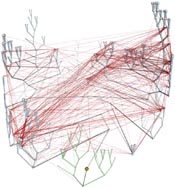
A bird's-eye view of the tree of life, showing the vines in red and the tree's branches in grey [Bacteria] and green [Archaea]. The last universal common ancestor is shown as a yellow sphere.EBI researchers have changed our view of 4 billion years of microbial evolution. Christos Ouzounis and colleagues have gained intriguing quantitative insights into how gene families are transferred, not only 'vertically' through passage from one organism to its progeny, but also 'horizontally' through the exchange of genetic material between distantly related organisms. This new view of the tree of life could help us to better understand how disease-causing bacteria manage to stay one step ahead of us in our battle to tackle antibiotic resistance.

| Microbiology | July 3, 2005 08:44 PM |
| Full story | 2 Comments | 13758 views |

| Molecular & Cell Biology | July 3, 2005 07:43 PM |
Researchers at UT Southwestern Medical Center have found an enzyme vital for controlling the early stages of cell death – a beneficial and normal process when it works right, but malignant in a variety of cancers when it malfunctions.
The researchers are now examining tissue from cancer patients to try to determine how mutations in the enzyme’s gene may relate to cancer.
| Full story | 0 Comments | 5387 views |
| Microbiology | July 3, 2005 06:36 PM |
Identification of soils that inhibit a tiny soybean-destroying organism is an important tool in reducing yield losses, according to a Purdue University plant pathologist.
| Full story | 0 Comments | 5400 views |
| Molecular & Cell Biology | July 3, 2005 05:35 PM |
When microorganisms invade the body, immune mechanisms kick in to fight them off. The infected tissues typically show depleted oxygen levels, and a protein called HIF-1 alpha regulates this. Interestingly, the cells responsible for destroying the foreign pathogens are effective in this low-oxygen environment. In a new study appearing in the July 1 print issue of The Journal of Clinical Investigation, Randall Johnson and collegues from UCSD show for the first time that induction of the HIF-1 pathway can act as a "super-antibiotic", accelerating the killing of bacteria in conditions typical of those found during bacterial infection and sepsis.
| Full story | 0 Comments | 5925 views |

| Environment | July 3, 2005 03:28 PM |
Editor : This one is ironic; reduce emissions, and temperature would still 'rise' because it's too clean? Right...
Global warming may proceed more quickly and be more severe than previously predicted according to research about to be published in the scientific journal "Nature". Reductions in airborne particle pollution, or aerosols, as air quality is improved, will amplify climate change by reducing the cooling effect due to aerosols and also by increasing the amount of carbon dioxide that remains in the atmosphere. Uncertainty about the magnitude of past and present cooling, however, means that we cannot be certain about the strength of future warming, which may exceed previous estimates.
| Full story | 0 Comments | 5562 views |
| Microbiology | July 3, 2005 02:27 PM |
A gene enabling an insect virus to enter new cells was likely stolen from a host cell and adapted for the virus's use, researchers at Boyce Thompson Institute (BTI) at Cornell University report.
| Full story | 0 Comments | 5040 views |

| Health & Medicine | July 3, 2005 12:26 PM |
Yale has been offered $17 million from the Grand Challenges in Global health initiative to genetically engineer mice with immune systems similar enough to humans to aid in testing the safety and effectiveness of potential vaccines.
| Full story | 0 Comments | 4578 views |
| Health & Medicine | July 3, 2005 12:25 PM |
Combating the spread of malaria by manipulating the mosquitoes' sense of smell is the object of an ambitious research project, led by Vanderbilt University, that has been selected to receive $8.5 million as part of the Grand Challenges to Global Health.
| Full story | 0 Comments | 5282 views |
| Health & Medicine | July 3, 2005 10:24 AM |
Drug abusers are increasingly turning to a slow-release form of a powerful painkiller for a quick and dangerous high, University of Florida researchers warn. The trend is raising alarm as the number of people dying from an overdose of the drug fentanyl, an opioid 100 times more potent than morphine, rises.
| Full story | 0 Comments | 6555 views |

- In some genetic cases of microcephaly, stem cells fail to launch
- Yale team discovers how Zika virus causes fetal brain damage
- Scientists uncover the way a common cell enzyme alerts the body to invading bacteria
- Arctic gives clues on worst mass extinction of life
- Calcium channel blockers caught in the act at atomic level
Search Bio News Net
Free Biology Newsletter
- Flexibility That A.C.A. Lent to Work Force Is Threatened by...International Herald Tribune
- Bacteria Behind Legionnaires’ Disease Found at New York Police StationInternational Herald Tribune
- Prescription Price Crisis? 28 Million Americans See Spike in Drug...MSNBC.com: Health
- Seizing on Opioid Crisis, a Drug Maker Lobbies Hard for...International Herald Tribune
- Republicans are taking a big political risk on health careAP Health News
- Why We're So Divided Over Saving WolvesNational Geographic News