

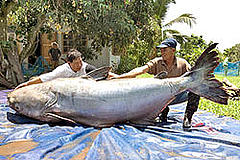
Fishermen in northern Thailand have netted a fish as big as a grizzly bear, a 646-pound Mekong giant catfish, the heaviest recorded since Thai officials started keeping records in 1981. The behemoth was caught in the Mekong River and may be the largest freshwater fish ever found.

| Biology | July 1, 2005 08:37 PM |
| Full story | 0 Comments | 17233 views |
| Biology | July 1, 2005 07:57 PM |
A study, published today in the prestigious journal Nature by Dr. Michael Petrides and colleagues at the Montreal Neurological Institute (MNI) at McGill University, challenges current thinking that speech developed as a result of new structures that evolved in the human brain. Dr. Petrides and colleagues have identified a distinct brain region that controls jaw movements in macaque monkeys that is comparable to Broca's area - the region in the human brain critical for speech production. This discovery is important as it suggests that this area of the brain evolved originally to perform high-order control over the mouth and the jaw, and that as humans evolved this area came to control the movements necessary for speech.
| Full story | 0 Comments | 5156 views |
| Biology | July 1, 2005 06:44 PM |
Size doesn't matter, at least not the size of the eyespots on a male butterfly's wings when female butterflies consider potential mates.
Instead, females are attracted to the "sparkle" created by the ultraviolet reflectivity of the pupils, the white circles at the center of eyespots, according to new research from University at Buffalo biologists.
| Full story | 0 Comments | 5972 views |

| Biotechnology | July 1, 2005 05:42 PM |

By adding electrodes to the tip of an atomic force microscope, researchers created a tool that can monitor many activities at the same time."Usually people image topography and then measure the biological activity," said Christine Kranz, research scientist at Georgia Tech "But if you think about having biological material, it's changing with time. So scanning for these sequentially may mean that the structure and activity level of your sample has changed and you're not looking at the same condition of your sample anymore."
| Full story | 0 Comments | 6130 views |
| Biology | July 1, 2005 04:41 PM |
Comparative studies of captive breeding strategies conducted at Rice University bolster the case for costly and sometimes troublesome breeding programs that preserve maximum genetic variability in small populations of endangered species.
| Full story | 0 Comments | 4845 views |
| Biology | July 1, 2005 01:36 PM |
Ohio State University will lead an interdisciplinary team of scientists in a multi-million dollar project to help improve one of the most important food crops in Africa, cassava.
The Bill and Melinda Gates Foundation selected the BioCassava Plus project as a recipient of one of the foundation's "Grand Challenges in Global Health" program grants. Created two years ago, the goal of the $450 million program is to fund innovative solutions to global health problems.
| Full story | 0 Comments | 4731 views |

| Environment | July 1, 2005 12:35 PM |
Wildfires in Alaska and Canada in 2004 emitted about as much carbon monoxide as did human-related activities in the continental United States during the same time period, according to new research by the National Center for Atmospheric Research (NCAR). The fires also increased atmospheric concentrations of ground-level ozone across much of the Northern Hemisphere.
| Full story | 0 Comments | 5182 views |

- In some genetic cases of microcephaly, stem cells fail to launch
- Yale team discovers how Zika virus causes fetal brain damage
- Scientists uncover the way a common cell enzyme alerts the body to invading bacteria
- Arctic gives clues on worst mass extinction of life
- Calcium channel blockers caught in the act at atomic level
Search Bio News Net
Free Biology Newsletter
- Flexibility That A.C.A. Lent to Work Force Is Threatened by...International Herald Tribune
- Bacteria Behind Legionnaires’ Disease Found at New York Police StationInternational Herald Tribune
- Prescription Price Crisis? 28 Million Americans See Spike in Drug...MSNBC.com: Health
- Seizing on Opioid Crisis, a Drug Maker Lobbies Hard for...International Herald Tribune
- Republicans are taking a big political risk on health careAP Health News
- Why We're So Divided Over Saving WolvesNational Geographic News