

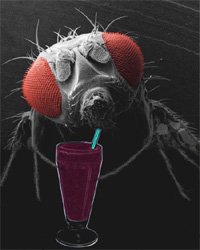
Photo: Partridge et al.In April, the United States Centers for Disease Control and Prevention released a study challenging the conventional wisdom that eating less promotes longevity. Now, in a new study in the premier open access journal PLoS Biology, William Mair, Matthew Piper, and Linda Partridge show that flies can actually live longer without reducing calories by eating proportionally less yeast, supporting the notion that calorie-restriction-induced longevity may not be as universal as once thought.

| Biology | May 31, 2005 08:33 PM |
| Full story | 0 Comments | 6252 views |
| Biology | May 31, 2005 08:32 PM |
You just can't tell where you might find love these days. A team led by a neuroscientist, an anthropologist and a social psychologist found love-related neurophysiological systems inside a magnetic resonance imaging machine. They detected quantifiable love responses in the brains of 17 young men and women who each described themselves as being newly and madly in love.
| Full story | 0 Comments | 7905 views |

| Molecular & Cell Biology | May 31, 2005 08:30 PM |
Scientists have for the first time mapped multiple complex biological interactions in a yeast cell in a simple graphical form, enhancing our understanding of how the networks of interaction by which components of a cell influence one another. New research published in the Open Access journal Journal of Biology shows that such maps can also reveal cryptic interactions and enable accurate predictions about interactions that haven't been observed experimentally.
| Full story | 0 Comments | 6169 views |
| Biology | May 31, 2005 08:29 PM |
Just as disturbance makes a landscape susceptible to invasion by alien plant species, the construction of reservoirs around the globe could be contributing to the accelerating spread of exotic aquatic species, according to a Forum article in the June 2005 issue of BioScience. John A. Havel of Southwest Missouri State University and Carol Eunmi Lee and M. Jake Vander Zanden of the University of Wisconsin survey evidence indicating that the physical and biological properties of reservoirs make them more likely to be invaded by exotic species than natural lakes. The researchers point to cases in which reservoirs are believed to have facilitated the rapid spread of invasive species.
| Full story | 0 Comments | 5657 views |
| Molecular & Cell Biology | May 31, 2005 08:28 PM |
To be published in the June 1 issue of G&D, Dr. Thomas Tuschl and colleagues describe the most comprehensive profile to date of microRNA (miRNA) expression during zebrafish development. The authors cloned 154 distinct miRNAs (10 of which are completely novel) in a developmental and tissue-specific manner.
| Full story | 0 Comments | 6553 views |
| Molecular & Cell Biology | May 31, 2005 08:27 PM |
New research shows that exposure to harmful chemicals and drugs during critical developmental periods early in life may actually "reprogram" the way certain genes respond to the female hormone estrogen. This genetic reprogramming may determine whether people with a genetic predisposition for a disease actually develop the disease.
| Full story | 0 Comments | 5928 views |

- In some genetic cases of microcephaly, stem cells fail to launch
- Yale team discovers how Zika virus causes fetal brain damage
- Scientists uncover the way a common cell enzyme alerts the body to invading bacteria
- Arctic gives clues on worst mass extinction of life
- Calcium channel blockers caught in the act at atomic level
Search Bio News Net
Free Biology Newsletter
- Flexibility That A.C.A. Lent to Work Force Is Threatened by...International Herald Tribune
- Bacteria Behind Legionnaires’ Disease Found at New York Police StationInternational Herald Tribune
- Prescription Price Crisis? 28 Million Americans See Spike in Drug...MSNBC.com: Health
- Seizing on Opioid Crisis, a Drug Maker Lobbies Hard for...International Herald Tribune
- Republicans are taking a big political risk on health careAP Health News
- Why We're So Divided Over Saving WolvesNational Geographic News