

The discovery of a new species of human relative was announced today, 10 September 2015, by the University of the Witwatersrand (Wits University), the National Geographic Society and the Department of Science and Technology (DST) and the National Research Foundation of South Africa (NRF).

| Health & Medicine | September 10, 2015 06:45 PM |
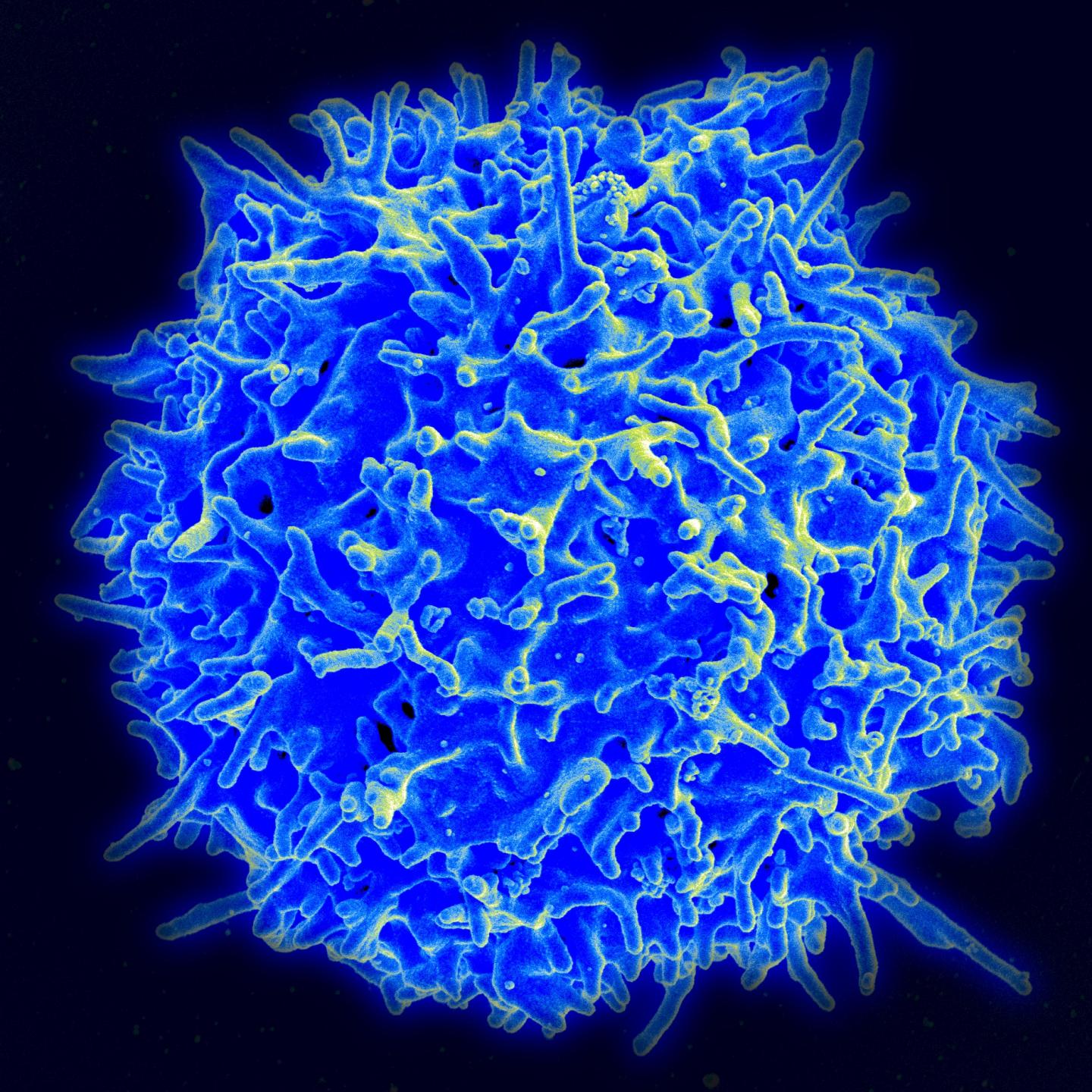
This is a scanning electron micrograph of a human T lymphocyte from the immune system of a healthy donor. Sometimes when the immune system makes small mistakes, the body amplifies its response in a big way: Editing errors in the DNA of developing T and B cells can cause blood cancers. Now, researchers from the Perelman School of Medicine, University of Pennsylvania have shown that when the enzyme key to cutting and pasting segments of DNA hits so-called "off-target" spots on a chromosome, the development of immune cells can lead to cancer in animal models. Knowing the exact nature of these editing errors will be helpful in designing therapeutic enzymes based on these molecular scissors. The Penn team's findings appear online this week in Cell Reports ahead of the print issue.
| Full story | 0 Comments | 7773 views |

| Biology | September 10, 2015 06:45 PM |
The ants become aggressive in response to the elongated projections (spotted patterns) of the larvae. Project Assistant Professor HOJO Masaru of Kobe University, Graduate School of Science, and joint research groups at the University of the Ryukyus and Harvard University have discovered that lycaenid butterfly larvae, which are in a symbiotic relationship with ants, can control the effect of dopamine by supplying the ants with nectar. The results of this study provide novel insight into the phenomenon of symbiosis and give clues about the physiological functions of dopamine. The study was published in Current Biology on July 31.
| Full story | 0 Comments | 8527 views |

- In some genetic cases of microcephaly, stem cells fail to launch
- Yale team discovers how Zika virus causes fetal brain damage
- Scientists uncover the way a common cell enzyme alerts the body to invading bacteria
- Arctic gives clues on worst mass extinction of life
- Calcium channel blockers caught in the act at atomic level
Search Bio News Net
Free Biology Newsletter
- Flexibility That A.C.A. Lent to Work Force Is Threatened by...International Herald Tribune
- Bacteria Behind Legionnaires’ Disease Found at New York Police StationInternational Herald Tribune
- Prescription Price Crisis? 28 Million Americans See Spike in Drug...MSNBC.com: Health
- Seizing on Opioid Crisis, a Drug Maker Lobbies Hard for...International Herald Tribune
- Republicans are taking a big political risk on health careAP Health News
- Why We're So Divided Over Saving WolvesNational Geographic News