

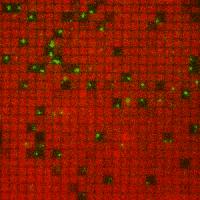
This gif of membrane-anchored Ras (red) and individual SOS molecules (green) shows individual SOS molecules corralled into nanofabricated patches where all the membrane-associated Ras molecules they activate can be trapped. A breakthrough discovery into how living cells process and respond to chemical information could help advance the development of treatments for a large number of cancers and other cellular disorders that have been resistant to therapy. An international collaboration of researchers, led by scientists with the U.S. Department of Energy (DOE)'s Lawrence Berkeley National Laboratory (Berkeley Lab) and the University of California (UC) Berkeley, have unlocked the secret behind the activation of the Ras family of proteins, one of the most important components of cellular signaling networks in biology and major drivers of cancers that are among the most difficult to treat.

| Molecular & Cell Biology | July 3, 2014 07:08 PM |
| Full story | 0 Comments | 7057 views |

| Environment | July 3, 2014 07:08 PM |
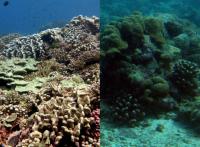
On the left is a coral-covered reef. On the right is one dominated by algae. A new study by biologists at San Diego State University and Scripps Institution of Oceanography shows that inhabited coral islands that engage in commercial fishing dramatically alter their nearby reef ecosystems, disturbing the microbes, corals, algae and fish that call the reef home.
| Full story | 0 Comments | 6309 views |
| Molecular & Cell Biology | July 3, 2014 07:08 PM |
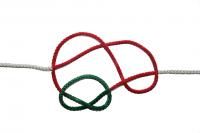
One of the knots grows in size, while the other diffuses along the contour of the former. Physicists of Johannes Gutenberg University Mainz (JGU) and the Graduate School of Excellence "Materials Science in Mainz" (MAINZ) have been able with the aid of computer simulations to confirm and explain a mechanism by which two knots on a DNA strand can interchange their positions. For this, one of the knots grows in size while the other diffuses along the contour of the former. Since there is only a small free energy barrier to swap, a significant number of crossing events have been observed in molecular dynamics simulations, i.e., there is a high probability of such interchange of positions.
| Full story | 0 Comments | 5604 views |

- In some genetic cases of microcephaly, stem cells fail to launch
- Yale team discovers how Zika virus causes fetal brain damage
- Scientists uncover the way a common cell enzyme alerts the body to invading bacteria
- Arctic gives clues on worst mass extinction of life
- Calcium channel blockers caught in the act at atomic level
Search Bio News Net
Free Biology Newsletter
- Flexibility That A.C.A. Lent to Work Force Is Threatened by...International Herald Tribune
- Bacteria Behind Legionnaires’ Disease Found at New York Police StationInternational Herald Tribune
- Prescription Price Crisis? 28 Million Americans See Spike in Drug...MSNBC.com: Health
- Seizing on Opioid Crisis, a Drug Maker Lobbies Hard for...International Herald Tribune
- Republicans are taking a big political risk on health careAP Health News
- Why We're So Divided Over Saving WolvesNational Geographic News