


Hunting in the ocean's murky depths, vision is of little use, so toothed whales and dolphins (odontocetes) rely on echolocation to locate tasty morsels with incredible precision. Laura Kloepper from the University of Hawaii, USA, explains that odontocetes produce their distinctive echolocation clicks in nasal structures in the forehead and broadcast them through a fat-filled acoustic lens, called the melon. 'Studies by other people showed odontocetes have the ability to control the shape of the echolocation beam and it has always been assumed that they are using the melon to focus sound' explains Kloepper. However, no one had ever tested this directly, so Kloepper and her PhD supervisor, Paul Nachtigall, decided to tackle the question. They publish their discovery that false killer whales are able to focus their echolocation beams on targets in The Journal of Experimental Biology at http://jeb.biologists.org.

| Stem Cell Research | March 22, 2012 08:05 PM |
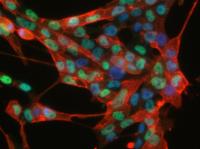
This is an immunofluorescence microscopy image of the induced neural stem cells (iNSCs) using antibodies against two neural stem cell markers SSEA1 (red color) and Olig2 (green color). Breaking new ground, scientists at the Max Planck Institute for Molecular Biomedicine in Münster, Germany, have succeeded in obtaining somatic stem cells from fully differentiated somatic cells. Stem cell researcher Hans Schöler and his team took skin cells from mice and, using a unique combination of growth factors while ensuring appropriate culturing conditions, have managed to induce the cells' differentiation into neuronal somatic stem cells. "Our research shows that reprogramming somatic cells does not require passing through a pluripotent stage," explains Schöler. "Thanks to this new approach, tissue regeneration is becoming a more streamlined - and safer - process."
| Full story | 0 Comments | 11627 views |

- In some genetic cases of microcephaly, stem cells fail to launch
- Yale team discovers how Zika virus causes fetal brain damage
- Scientists uncover the way a common cell enzyme alerts the body to invading bacteria
- Arctic gives clues on worst mass extinction of life
- Calcium channel blockers caught in the act at atomic level
Search Bio News Net
Free Biology Newsletter
- Flexibility That A.C.A. Lent to Work Force Is Threatened by...International Herald Tribune
- Bacteria Behind Legionnaires’ Disease Found at New York Police StationInternational Herald Tribune
- Prescription Price Crisis? 28 Million Americans See Spike in Drug...MSNBC.com: Health
- Seizing on Opioid Crisis, a Drug Maker Lobbies Hard for...International Herald Tribune
- Republicans are taking a big political risk on health careAP Health News
- Why We're So Divided Over Saving WolvesNational Geographic News