

Thanks to Hollywood, piranhas have a bad reputation and it would be a brave scientist that chose to plunge their hand into a tank of them. But that didn't deter Sandie Millot, Pierre Vandewalle and Eric Parmentier from the University of Liège, Belgium. 'You just have to pick them up and they make sounds,' says Parmentier. However, it wasn't clear when and why piranhas produce sounds naturally. Intrigued by fish acoustic communication and the mechanisms that they use to generate sound, the team monitored the behaviour of small groups of captive red-bellied piranhas and publish their discovery that the fearsome fish have a repertoire of three combative sounds in The Journal of Experimental Biology at http://jeb.biologists.org.

| Biology | October 13, 2011 05:21 PM |
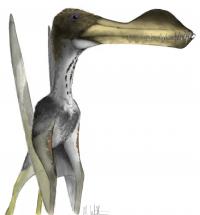
This is an image of a giant pterosaur, Coloborhynchus New research from the Universities of Portsmouth and Leicester has identified a small fossil fragment at the Natural History Museum, London as being part of a giant pterosaur – setting a new upper limit for the size of winged and toothed animals.
| Full story | 0 Comments | 11162 views |

| Stem Cell Research | October 13, 2011 05:21 PM |
This research, published on Oct. 12 on the Nature review website, provides evidence of a major concept could pave the way for the future use of these stem cells to treat humans, through perspective gene therapies. For several years now, scientists have been able to produce cells with stem cell properties, by using specialized and mature cells from our body, such as skin cells. These 'iPS' stem cells are said to be "pluripotent': they can provide specialized cells, upon demand, with the same gene pool as the original cells. iPS cells represent a potential basis for the exploration of several therapeutic areas, particularly transplants or gene therapy. However, to date research conducted on these cells had not provided proof of their potential in vivo efficiency for the aforementioned types of use.
| Full story | 0 Comments | 10374 views |

| Gene Therapy | October 13, 2011 05:21 PM |
National Institutes of Health-funded scientists have corrected sickle cell disease in adult laboratory mice by activating production of a special blood component normally produced before, but not after, birth.
| Full story | 0 Comments | 11065 views |
| Biology | October 13, 2011 05:21 PM |
Recognizing other individuals from their voices is second nature to humans. Certain primates also have this ability. Whether other mammals that live in social groups are also able to do so, however, is unclear. Like with primates, vocal communication is vital for meerkats. They coordinate their activities with calls, such as to warn other group members of approaching predators, for instance, and thus stick together as a group. Behavior biologists from the University of Zurich have already managed to decipher many calls in meerkat communication. Now, however, they have become the first to establish that meerkats are able to distinguish individual calls.
| Full story | 0 Comments | 7513 views |

- In some genetic cases of microcephaly, stem cells fail to launch
- Yale team discovers how Zika virus causes fetal brain damage
- Scientists uncover the way a common cell enzyme alerts the body to invading bacteria
- Arctic gives clues on worst mass extinction of life
- Calcium channel blockers caught in the act at atomic level
Search Bio News Net
Free Biology Newsletter
- Flexibility That A.C.A. Lent to Work Force Is Threatened by...International Herald Tribune
- Bacteria Behind Legionnaires’ Disease Found at New York Police StationInternational Herald Tribune
- Prescription Price Crisis? 28 Million Americans See Spike in Drug...MSNBC.com: Health
- Seizing on Opioid Crisis, a Drug Maker Lobbies Hard for...International Herald Tribune
- Republicans are taking a big political risk on health careAP Health News
- Why We're So Divided Over Saving WolvesNational Geographic News