

A compound tested by UT Southwestern Medical Center investigators destroys several viruses, including the deadly Spanish flu that killed an estimated 30 million people in the worldwide pandemic of 1918.
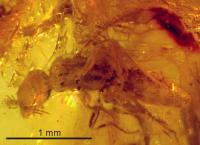
This is a holotype of Plumalexius rasnitsyni. After being alerted by Alexandr Rasnitsyn (Palaeontological Institute of the Russian Academy of Sciences, Moscow) to two unusual wasps in amber found in New Jersey, USA, Denis Brothers (University of KwaZulu-Natal, South Africa) has determined that they represent a new family of wasps, but with its closest relatives found in South America and South Africa. The study was published in a special issue of the open-access journal ZooKeys dedicated to the 75th birthday of Professor Rasnitsyn.
| Full story | 0 Comments | 10072 views |

| Molecular & Cell Biology | September 26, 2011 02:58 PM |
The mitochondria are the cell's power stations. In animal cells, they supply energy in usable form by converting nutrients into the universal energy currency of the cell, adenosine triphosphate (ATP). Mitochondria possess their own DNA, and are inherited via the maternal line. The mitochondrial DNA codes for a small number of proteins that are essential for energy production in the organelle. The first step in the decoding of this genetic information is the synthesis, or transcription, of RNA copies of the DNA by the enzyme mitochondrial RNA polymerase. The RNA molecules are then used to program protein synthesis. However, exactly how the mitochondrial RNA polymerase actually works has not been clear, as its structure was unknown – until now. Biochemist Professor Patrick Cramer, Director of the Gene Center at LMU, in collaboration with Professor Dmitry Temiakov of the University of Medicine and Dentistry of New Jersey (USA), has now determined the architecture of this molecular copy machine. "With the help of a synchrotron as a source of radiation and using the method of X-ray diffraction, we were able to determine the first three-dimensional structure of a human polymerase, the mitochondrial RNA polymerase, in atomic detail," Cramer explains.
| Full story | 0 Comments | 8308 views |

- In some genetic cases of microcephaly, stem cells fail to launch
- Yale team discovers how Zika virus causes fetal brain damage
- Scientists uncover the way a common cell enzyme alerts the body to invading bacteria
- Arctic gives clues on worst mass extinction of life
- Calcium channel blockers caught in the act at atomic level
Search Bio News Net
Free Biology Newsletter
- Flexibility That A.C.A. Lent to Work Force Is Threatened by...International Herald Tribune
- Bacteria Behind Legionnaires’ Disease Found at New York Police StationInternational Herald Tribune
- Prescription Price Crisis? 28 Million Americans See Spike in Drug...MSNBC.com: Health
- Seizing on Opioid Crisis, a Drug Maker Lobbies Hard for...International Herald Tribune
- Republicans are taking a big political risk on health careAP Health News
- Why We're So Divided Over Saving WolvesNational Geographic News