

The Stowers Institute's Rong Li Lab has characterized a mechanism that allows for asymmetrical cell division during meiosis in oocytes. By tracking chromosome movement in live mouse oocytes, the team discovered that chromosomes can recruit to their vicinity a protein called formin-2. This protein allows the oocyte to retain the majority of the cytoplasm – a requirement for embryonic development after fertilization – while the other daughter cell (called a polar body) resulting from the asymmetric division gets only a minimal amount and subsequently dies.

| Environment | October 7, 2008 06:43 PM |
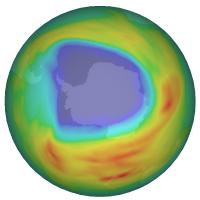
Ozone hole during Oct. 7, 2008, as measured by the Scanning Imaging Absorption Spectrometer for Atmospheric Cartography (SCIAMACHY) atmospheric sensor onboard ESA's Envisat. The 2008 ozone hole – a thinning in the ozone layer over Antarctica – is larger both in size and ozone loss than 2007 but is not as large as 2006.
| Full story | 0 Comments | 11896 views |

| Molecular & Cell Biology | October 7, 2008 06:43 PM |
By killing off "angry" immune cells that take up residence in obese fat and muscle tissue, researchers have shown that they can rapidly reverse insulin resistance in obese mice. The findings reported in the October Cell Metabolism, a publication of Cell Press, suggest that treatments aimed at specific subsets of the so-called macrophage cells might offer a very effective new antidiabetic therapy, according to the researchers.
| Full story | 0 Comments | 8435 views |
| Molecular & Cell Biology | October 7, 2008 06:43 PM |
A simulated gastrointestinal system is helping scientists test contaminated soil for its potential to harm humans. The method is likely to save time and money for people hoping to repurpose land with an industrial past.
| Full story | 0 Comments | 5081 views |
| Molecular & Cell Biology | October 7, 2008 06:43 PM |
A protein that enables nerve cells to communicate with each other plays a key role in controlling the developing nervous system. Research into how that protein helps precise connections to form among nerve cells may provide a basis for eventual treatments for patients who suffer injuries to their nervous system, including spinal cord injury.
| Full story | 0 Comments | 6241 views |

| Biology | October 7, 2008 10:41 AM |
The National Institutes of Health has awarded $4 million to a group of Philippine and American scientists led by Oregon Health & Science University to aid in the discovery of new molecules and biofuels technology from marine mollusks for development in the Philippines.
| Full story | 0 Comments | 6433 views |
| Environment | October 7, 2008 10:41 AM |
Health experts from the Wildlife Conservation Society today released a report that lists 12 pathogens that could spread into new regions as a result of climate change, with potential impacts to both human and wildlife health and global economies. Called The Deadly Dozen: Wildlife Diseases in the Age of Climate Change, the new report provides examples of diseases that could spread as a result of changes in temperatures and precipitation levels. The best defense, according to the report's authors, is a good offense in the form of wildlife monitoring to detect how these diseases are moving so health professionals can learn and prepare to mitigate their impact.
| Full story | 0 Comments | 6457 views |

- In some genetic cases of microcephaly, stem cells fail to launch
- Yale team discovers how Zika virus causes fetal brain damage
- Scientists uncover the way a common cell enzyme alerts the body to invading bacteria
- Arctic gives clues on worst mass extinction of life
- Calcium channel blockers caught in the act at atomic level
Search Bio News Net
Free Biology Newsletter
- Flexibility That A.C.A. Lent to Work Force Is Threatened by...International Herald Tribune
- Bacteria Behind Legionnaires’ Disease Found at New York Police StationInternational Herald Tribune
- Prescription Price Crisis? 28 Million Americans See Spike in Drug...MSNBC.com: Health
- Seizing on Opioid Crisis, a Drug Maker Lobbies Hard for...International Herald Tribune
- Republicans are taking a big political risk on health careAP Health News
- Why We're So Divided Over Saving WolvesNational Geographic News