

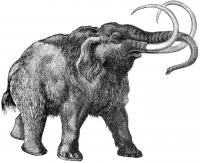
Drawing of a woolly mammoth. A large genetic study of the extinct woolly mammoth has revealed that the species was not one large homogenous group, as scientists previously had assumed, and that it did not have much genetic diversity. "The population was split into two groups, then one of the groups died out 45,000 years ago, long before the first humans began to appear in the region," said Stephan C. Schuster, associate professor of biochemistry and molecular biology at Penn State University and a leader of the research team. "This discovery is particularly interesting because it rules out human hunting as a contributing factor, leaving climate change and disease as the most probable causes of extinction." The discovery will be published later this week in the early online edition of the Proceedings of the National Academy of Sciences (PNAS).

| Biology | June 11, 2008 07:17 PM |
| Full story | 0 Comments | 11251 views |
| Biology | June 11, 2008 07:17 PM |
Flies, unlike humans, can't manipulate the temperature of their surroundings so they need to pick the best spot for flourishing. New Brandeis University research in this week's Nature reveals that they have internal thermosensors to help them.
| Full story | 0 Comments | 6385 views |

| Molecular & Cell Biology | June 11, 2008 07:17 PM |
Researchers at Tufts University School of Medicine and Tufts Medical Center have found that Smad proteins regulate microRNA (miRNA) processing. Understanding the role of Smad proteins enables researchers to investigate abnormal miRNA processing which is a contributing factor in development of cardiovascular disorders and cancer. The study was published online today in Nature.
| Full story | 0 Comments | 5350 views |
| Molecular & Cell Biology | June 11, 2008 07:17 PM |
A team of scientists from the University of Georgia and two European universities has, for the first time, synthesized and characterized the elusive parent molecule of an important class of chemical compounds.
| Full story | 0 Comments | 5812 views |
| Biology | June 11, 2008 07:17 PM |
Scientists have discovered that there are more bee species than previously thought. In the first global accounting of bee species in over a hundred years, John S. Ascher, a research scientist in the Division of Invertebrate Zoology at the American Museum of Natural History, compiled online species pages and distribution maps for more than 19,200 described bee species, showcasing the diversity of these essential pollinators. This new species inventory documents 2,000 more described, valid species than estimated by Charles Michener in the first edition of his definitive The Bees of the World published eight years ago.
| Full story | 0 Comments | 7530 views |
| Biology | June 11, 2008 07:17 PM |
The temperature inside a healthy, photosynthesizing tree leaf is affected less by outside environmental temperature than originally believed, according to new research from biologists at the University of Pennsylvania.
| Full story | 0 Comments | 6179 views |
| Molecular & Cell Biology | June 11, 2008 07:17 PM |
The proteins upon which life depends share an attribute with paper airplanes: Unless folded properly, they just won't fly.
| Full story | 0 Comments | 5328 views |

- In some genetic cases of microcephaly, stem cells fail to launch
- Yale team discovers how Zika virus causes fetal brain damage
- Scientists uncover the way a common cell enzyme alerts the body to invading bacteria
- Arctic gives clues on worst mass extinction of life
- Calcium channel blockers caught in the act at atomic level
Search Bio News Net
Free Biology Newsletter
- Flexibility That A.C.A. Lent to Work Force Is Threatened by...International Herald Tribune
- Bacteria Behind Legionnaires’ Disease Found at New York Police StationInternational Herald Tribune
- Prescription Price Crisis? 28 Million Americans See Spike in Drug...MSNBC.com: Health
- Seizing on Opioid Crisis, a Drug Maker Lobbies Hard for...International Herald Tribune
- Republicans are taking a big political risk on health careAP Health News
- Why We're So Divided Over Saving WolvesNational Geographic News