

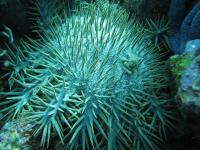
Outbreaks of crown of thorns starfish threaten the heart of the Coral Triangle in Indonesia. Outbreaks of the notorious crown of thorns starfish now threaten the “coral triangle,” the richest center of coral reef biodiversity on Earth, according to recent surveys by the Bronx Zoo-based Wildlife Conservation Society and ARC Centre of Excellence for Coral Reef Studies.

| Biology | January 14, 2008 04:52 PM |
| Full story | 0 Comments | 65755 views |

| Molecular & Cell Biology | January 14, 2008 04:52 PM |
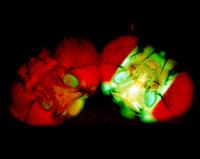
A magnified, straight-on view of two fruit flies under ultraviolet light. The fly on the right has been exposed to oltipraz, a compound that activates a major cancer-prevention pathway, and thus glows green brightly; the fly on the left has not. The technology allows researchers to quickly determine whether the pathway, a major source of anti-oxidant activity in people, is on or off. Credit: Photo courtesy of Dirk Bohmann/University of Rochester Medical Center A green glow from a fruit fly is giving researchers the green light when they are on the right path in their quest to develop compounds that help prevent cancer.
| Full story | 0 Comments | 5866 views |

| AIDS & HIV | January 14, 2008 01:39 PM |
UCLA researchers have found that a key protein in the body's dendritic cells can stop the virus that causes AIDS from "budding" — part of the virus' life cycle that is crucial to its ability to replicate and infect other cells.
| Full story | 0 Comments | 6781 views |
| Molecular & Cell Biology | January 14, 2008 12:39 PM |
Researchers have found a way to selectively block the ability of white blood cells to “crawl” toward the sites of injury and infection when such mobility drives disease, according to a study published today in The Journal of Experimental Medicine. The results suggest a new treatment approach for autoimmune diseases like rheumatoid arthritis, lupus and multiple sclerosis, and for conditions made worse by misplaced inflammation, like atherosclerosis, stroke and transplant rejection, researchers said.
| Full story | 0 Comments | 4428 views |

| Health & Medicine | January 14, 2008 11:39 AM |
A rapid and accurate DHPLC assay for determination of apolipoprotein E genotypes has been developed by researchers from the Department of Medical Genetics, School of Basic Medical Sciences, Southern Medical University, Guangzhou, China. This assay combines PCR and DHPLC and can be used to conduct efficient genotyping of the human population, which in turn will help in the diagnosis and treatment of Alzheimer’s disease. A description of the assay has been published this month in the Journal of Alzheimer’s Disease.
| Full story | 0 Comments | 5906 views |
| Biology | January 14, 2008 10:39 AM |
Recognising people, objects or animals by the sound they make is an important survival skill and something most of us take for granted. But very similar objects can physically make very dissimilar sounds and we are able to pick up subtle clues about the identity and source of the sound. Scientists funded by the Biotechnology and Biological Sciences Research Council (BBSRC) are working out how the human ear and the brain come together to help us understand our acoustic environment. They have found that the part of the brain that deals with sound, the auditory cortex, is adapted in each individual and tuned to the world around us. We learn throughout our lives how to localise and identify different sounds. It means that if you could hear the world through someone else's ears it would sound very different to what you are used to.
| Full story | 0 Comments | 6758 views |
| Biology | January 14, 2008 09:39 AM |
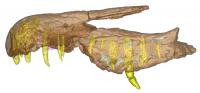
This image shows the results of the CT scan reconstruction. The Baryonyx snout bone is transparent brown. This shows us that the teeth (yellow) had extremely deep roots and that Baryonyx had independently evolved a bony palate (the pink structure), also seen in crocodilians -- another feature that makes this dinosaur even more 'crocodile-like'. Credit: Emily Rayfield An unusual dinosaur has been shown to have a skull that functioned like a fish-eating crocodile, despite looking like a dinosaur. It also possessed two huge hand claws, perhaps used as grappling hooks to lift fish from the water.
| Full story | 0 Comments | 7654 views |

- In some genetic cases of microcephaly, stem cells fail to launch
- Yale team discovers how Zika virus causes fetal brain damage
- Scientists uncover the way a common cell enzyme alerts the body to invading bacteria
- Arctic gives clues on worst mass extinction of life
- Calcium channel blockers caught in the act at atomic level
Search Bio News Net
Free Biology Newsletter
- Flexibility That A.C.A. Lent to Work Force Is Threatened by...International Herald Tribune
- Bacteria Behind Legionnaires’ Disease Found at New York Police StationInternational Herald Tribune
- Prescription Price Crisis? 28 Million Americans See Spike in Drug...MSNBC.com: Health
- Seizing on Opioid Crisis, a Drug Maker Lobbies Hard for...International Herald Tribune
- Republicans are taking a big political risk on health careAP Health News
- Why We're So Divided Over Saving WolvesNational Geographic News