

People from different cultures use their brains differently to solve the same visual perceptual tasks, MIT researchers and colleagues report in the first brain imaging study of its kind.

| Environment | January 12, 2008 07:40 PM |
U.S. Forest Service and U.C. Santa Barbara scientists believe they have identified the habitat needs for Pacific fishers, a rare California mammal that is a candidate for reintroduction efforts and listing under the Endangered Species Act.
| Full story | 0 Comments | 5491 views |

| Biology | January 12, 2008 06:40 PM |
In the latest issue of the journal Emerging Infectious Diseases, Swedish researchers report that birds captured in the hyperboreal tundra, in connection with the tundra expedition “Beringia 2005,” were carriers of antibiotics-resistant bacteria. These findings indicate that resistance to antibiotics has spread into nature, which is an alarming prospect for future health care.
| Full story | 0 Comments | 5028 views |
| Biology | January 12, 2008 05:40 PM |
The roundworm C. elegans, a staple of laboratory research, may be key in unlocking one of the central biological mysteries: why we sleep. Researchers at the University of Pennsylvania School of Medicine report in this week’s advanced online edition of Nature that the round worm has a sleep-like state, joining most of the animal kingdom in displaying this physiology. This research has implications for explaining the evolution and purpose of sleep and sleep-like states in animals.
| Full story | 0 Comments | 6233 views |

| Molecular & Cell Biology | January 12, 2008 04:40 PM |
University of Pennsylvania School of Medicine researchers have answered long-running questions about the way that anesthetics act on the body, by showing that the cellular pathway for emerging from anesthesia is different from the one that drugs take to put patients to sleep during operations. The findings will be published this week in Proceedings of the National Academy of Sciences.
| Full story | 0 Comments | 4671 views |
| Biology | January 12, 2008 03:40 PM |
Many researchers have tried to create a mathematical model of how cells pack together to form tissue, but most models have many different complicated factors, and no model is universal.
| Full story | 0 Comments | 4476 views |
| Biology | January 12, 2008 02:40 PM |
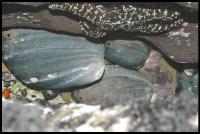
A rare occurrence in Southern California-black abalone cluster together in a rocky, intertidal crag on San Nicolas Island. NOAA Fisheries Service published with the Federal Register today a proposed rule to list black abalone, a marine mollusk coveted by fishermen and gourmets alike, as endangered under the Endangered Species Act (ESA). The proposal comes after NOAA Fisheries Service considered the report of a scientific review team concluding that the species is at risk of extinction.
| Full story | 0 Comments | 5475 views |
| Environment | January 12, 2008 01:40 PM |
The last fish you ate probably came from the Bering Sea.
| Full story | 0 Comments | 6957 views |

| Stem Cell Research | January 12, 2008 12:40 PM |
Scientists at the Johns Hopkins Kimmel Cancer Center say they have evidence that cancer stem cells for multiple myeloma share many properties with normal stem cells and have multiple ways of resisting chemotherapy and other treatments.
| Full story | 0 Comments | 7193 views |
| Molecular & Cell Biology | January 12, 2008 11:40 AM |
Nucleonics, Inc., a privately held biotechnology company focused on the development of novel RNA interference (RNAi)-based therapeutics, announced today that the company has begun treating patients in a Phase 1 human safety study of its experimental treatment for chronic Hepatitis B virus (HBV) infection, NUC B1000.
| Full story | 0 Comments | 5425 views |

| AIDS & HIV | January 12, 2008 10:40 AM |
New structural details illustrate how a promising class of antibodies may block human immunodeficiency virus (HIV)-1 infection and reveal valuable clues for design of an effective HIV-1 vaccine. The findings, published by Cell Press in the January issue of Immunity, are particularly significant as antibody induction appears to be a key and necessary component of an effective HIV vaccine, evidenced by the recent failure of vaccines that stimulated only the T cell arm of the immune system to protect humans from contracting HIV-1.
| Full story | 0 Comments | 5995 views |
| Molecular & Cell Biology | January 12, 2008 09:40 AM |
MIT scientists have found a new way that DNA can carry out its work that is about as surprising as discovering that a mold used to cast a metal tool can also serve as a tool itself, with two complementary shapes each showing distinct functional roles.
| Full story | 0 Comments | 4621 views |

- In some genetic cases of microcephaly, stem cells fail to launch
- Yale team discovers how Zika virus causes fetal brain damage
- Scientists uncover the way a common cell enzyme alerts the body to invading bacteria
- Arctic gives clues on worst mass extinction of life
- Calcium channel blockers caught in the act at atomic level
Search Bio News Net
Free Biology Newsletter
- Flexibility That A.C.A. Lent to Work Force Is Threatened by...International Herald Tribune
- Bacteria Behind Legionnaires’ Disease Found at New York Police StationInternational Herald Tribune
- Prescription Price Crisis? 28 Million Americans See Spike in Drug...MSNBC.com: Health
- Seizing on Opioid Crisis, a Drug Maker Lobbies Hard for...International Herald Tribune
- Republicans are taking a big political risk on health careAP Health News
- Why We're So Divided Over Saving WolvesNational Geographic News