

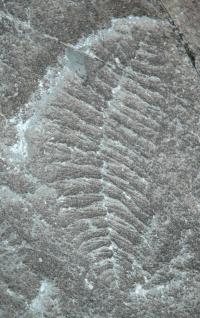
The Ediacara fossil Fractofusus andersoni from the ~565 million year old Mistaken Point Formation in Newfoundland, Canada, represents the earliest Ediacara assemblage, known as the Avalon assemblage. Scientists have known for some time that most major groups of complex animals appeared in the fossils record during the Cambrian Explosion, a seemingly rapid evolutionary event that occurred 542 million years ago. Now Virginia Tech paleontologists, using rigorous analytical methods, have identified another explosive evolutionary event that occurred about 33 million years earlier among macroscopic life forms unrelated to the Cambrian animals. They dubbed this earlier event the "Avalon Explosion."

| Biology | January 3, 2008 08:52 PM |
| Full story | 1 Comment | 9484 views |
| Biology | January 3, 2008 08:52 PM |
Practice makes perfect — or at least that’s what we’re told as we struggle through endless rounds of multiplication tables, goal kicks and piano scales — and it seems, based on the personal experience of many, to be true. That’s why neuroscientists have been perplexed by data showing that at the level of individual synapses, or connections between neurons, increased, repetitive stimulation might actually reverse early gains in synaptic strength. Now, neuroscientists from Carnegie Mellon University and the Max Planck Institute have discovered the mechanism that resolves this apparent paradox. The findings are published in the Jan. 4 issue of Science.
| Full story | 0 Comments | 5942 views |

| Molecular & Cell Biology | January 3, 2008 06:06 PM |
Even small mistakes made by cells during protein production can have profound disease effects, but the processes cells use to correct mistakes have been challenging to decipher. Recent work by scientists at The Scripps Research Institute, however, has uncovered two surprising new methods for such editing.
| Full story | 0 Comments | 5700 views |

| AIDS & HIV | January 3, 2008 05:06 PM |
Two simple changes in its outer envelope protein could render the AIDS virus vulnerable to attack by the immune system, according to research from Kenya and the Fred Hutchinson Cancer Research Center published in PLoS Medicine.
| Full story | 0 Comments | 6743 views |
| Molecular & Cell Biology | January 3, 2008 04:06 PM |
Dynamic networks of growing actin filaments are critical for many cellular processes, including cell migration, intracellular transport, and the recovery of proteins from the cell surface. In this week’s issue of the open-access journal PLoS Biology, researchers at Washington University in St. Louis shed light on how multiple proteins cooperate to regulate the assembly of such actin networks.
| Full story | 0 Comments | 6014 views |

| Health & Medicine | January 3, 2008 03:06 PM |
Bright light therapy can ease bipolar depression in some patients, according to a study published in the journal Bipolar Disorders. Researchers from the University of Pittsburgh School of Medicine’s Western Psychiatric Institute and Clinic studied nine women with bipolar disorder to examine the effects of light therapy in the morning or at midday on mood symptoms.
| Full story | 0 Comments | 7092 views |

| Gene Therapy | January 3, 2008 02:06 PM |
Researchers at Johns Hopkins and Ohio State University have found that the number of copies of a particular gene can affect the severity of colon cancer in a mouse model. Publishing in the Jan. 3 issue of Nature, the research team describes how trisomy 21, or Down syndrome in humans, can repress tumor growth.
| Full story | 0 Comments | 9019 views |
| Biology | January 3, 2008 01:06 PM |
Asteroid impacts or massive volcanic flows might have occurred around the time dinosaurs became extinct, but a new book argues that the mightiest creatures the world has ever known may have been brought down by a tiny, much less dramatic force – biting, disease-carrying insects.
| Full story | 0 Comments | 10852 views |

- In some genetic cases of microcephaly, stem cells fail to launch
- Yale team discovers how Zika virus causes fetal brain damage
- Scientists uncover the way a common cell enzyme alerts the body to invading bacteria
- Arctic gives clues on worst mass extinction of life
- Calcium channel blockers caught in the act at atomic level
Search Bio News Net
Free Biology Newsletter
- Flexibility That A.C.A. Lent to Work Force Is Threatened by...International Herald Tribune
- Bacteria Behind Legionnaires’ Disease Found at New York Police StationInternational Herald Tribune
- Prescription Price Crisis? 28 Million Americans See Spike in Drug...MSNBC.com: Health
- Seizing on Opioid Crisis, a Drug Maker Lobbies Hard for...International Herald Tribune
- Republicans are taking a big political risk on health careAP Health News
- Why We're So Divided Over Saving WolvesNational Geographic News