

Anybody who’s tried to concentrate on work while suffering a headache knows that pain compellingly commands attention—which is how evolution helped ensure survival in a painful world. Now, researchers have pinpointed the brain region responsible for pain’s ability to affect cognitive processing. They have found that this pain-related brain region is distinct from the one involved in cognitive processing interference due to a distracting memory task.

| Biology | July 5, 2007 10:23 PM |
The idea that animals other than humans can learn from one another and pass on local traditions has long been a matter of debate. Now, a new study reveals that some birds learn not only from each other, but also from their competitors. The findings appear online on July 5th in Current Biology, a Cell Press publication.
| Full story | 0 Comments | 4711 views |
| Biology | July 5, 2007 09:23 PM |
Researchers observed the behaviour of Great-tits foraging for artificial prey to understand more clearly how a species evolves to protect themselves from predators.
| Full story | 0 Comments | 5246 views |
| Biology | July 5, 2007 08:23 PM |
40 years ago, Prof. Dr. Wolfgang Wiltschko was the first to prove that migrating robins use the Earth’s magnetic field to direct themselves during migration. Their magnetic sensor showed them the course of the field lines of the Earth’s magnetic field. This produces an inclination compass that reacts to the inclination of the Earth’s magnetic field to the surface of the Earth, thus distinguishing between “pole-wards” (the side on which the field lines incline downwards) and “equator-wards” (the side on which they incline upwards). The inbuilt compass is additionally finely tuned to the field strength of the Earth’s local magnetic field, but can also be flexibly adapted to other field strengths that the birds encounter in the course of migration. Since that time a compass of this kind has been found in more than 20 species of birds, the majority of them being those songbirds that undertake annual migration. An international working group under the direction of Wolfgang und Roswitha Wiltschko of Frankfurt University has now succeeded in demonstrating the presence of a magnetic sense of direction in domestic chickens as well.
| Full story | 0 Comments | 6969 views |

| Molecular & Cell Biology | July 5, 2007 10:32 AM |
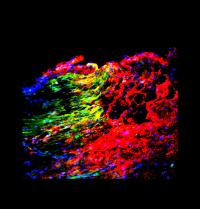
Fibrinogen (red) and activated EFGR (green) in the spinal cord after injury. Fibrinogen, a blood-clotting protein found in circulating blood, has been found to inhibit the growth of central nervous system neuronal cells, a process that is necessary for the regeneration of the spinal cord after traumatic injury. The findings by researchers at the University of California, San Diego (UCSD) School of Medicine, may explain why the human body is unable to repair itself after most spinal cord injuries.
| Full story | 0 Comments | 7117 views |

- In some genetic cases of microcephaly, stem cells fail to launch
- Yale team discovers how Zika virus causes fetal brain damage
- Scientists uncover the way a common cell enzyme alerts the body to invading bacteria
- Arctic gives clues on worst mass extinction of life
- Calcium channel blockers caught in the act at atomic level
Search Bio News Net
Free Biology Newsletter
- Flexibility That A.C.A. Lent to Work Force Is Threatened by...International Herald Tribune
- Bacteria Behind Legionnaires’ Disease Found at New York Police StationInternational Herald Tribune
- Prescription Price Crisis? 28 Million Americans See Spike in Drug...MSNBC.com: Health
- Seizing on Opioid Crisis, a Drug Maker Lobbies Hard for...International Herald Tribune
- Republicans are taking a big political risk on health careAP Health News
- Why We're So Divided Over Saving WolvesNational Geographic News