

An effective way to fight leukemia might be to knock out a specific protein that protects cancer cells from dying, a new study shows.

| Molecular & Cell Biology | April 21, 2007 06:58 PM |
Yale School of Medicine and University of Crete School of Medicine researchers report in Cell April 20 the first evidence of a molecular mechanism that dynamically alters the strength of higher brain network connections.
| Full story | 0 Comments | 7618 views |

| Biology | April 21, 2007 05:58 PM |
The most recent census of mountain gorillas in Uganda’s Bwindi Impenetrable National Park—one of only two places in the world where the rare gorillas exist—has found that the population has increased by 6 percent since the last census in 2002, according to the Uganda Wildlife Authority, the Wildlife Conservation Society, the Max Planck Institute of Anthropology and other groups that participated in the effort.
| Full story | 0 Comments | 7459 views |
| Biology | April 21, 2007 04:58 PM |
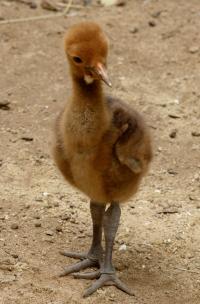
This rare wattled crane chick hatched at the Smithsonian's National Zoo on March 30. The chick is the National Zoo's first in its 118-year history. Visitors can see the wattled crane chick and its parents at the Zoo's Bird House outdoor exhibit. There are 63 wattled cranes in the North America zoo population and an estimated 8,000 in the wild. Adult wattled cranes stand 6 feet tall and weigh approximately 14 pounds. Credit: Jessie Cohen/Smithsonian's National Zoo Smithsonian's National Zoo has announced a first in its 118-year history -- the hatching of a rare wattled crane chick.
| Full story | 0 Comments | 7600 views |

| Health & Medicine | April 21, 2007 03:58 PM |
Crohn’s disease is a chronic relapsing inflammatory disorder of the intestinal tract that affects an estimated 0.15% of people in the developed world. Common symptoms include abdominal pain and diarrhea, but the disorder is often associated with debilitating clinical complications. Researchers from the University of Liège, Belgium, have now uncovered an important clue to the susceptibility of individuals to this disease.
| Full story | 0 Comments | 5372 views |
| Biology | April 21, 2007 01:58 PM |
The largest study to date of genetic variation among chimpanzees has found that the traditional, geography-based sorting of chimps into three populations—western, central and eastern—is underpinned by significant genetic differences, two to three times greater than the variation between the most different human populations.
| Full story | 0 Comments | 5224 views |
| Biology | April 21, 2007 11:58 AM |
The rise of the central nervous system (CNS) in animal evolution has puzzled scientists for centuries. Vertebrates, insects and worms evolved from the same ancestor, but their CNSs are different and were thought to have evolved only after their lineages had split during evolution. Researchers from the European Molecular Biology Laboratory (EMBL) in Heidelberg now reveal that the vertebrate nervous system is probably much older than expected. The study, which is published in the current issue of Cell, suggests that the last common ancestor of vertebrates, insects and worms already had a centralised nervous system resembling that of vertebrates today.
| Full story | 0 Comments | 6130 views |

- In some genetic cases of microcephaly, stem cells fail to launch
- Yale team discovers how Zika virus causes fetal brain damage
- Scientists uncover the way a common cell enzyme alerts the body to invading bacteria
- Arctic gives clues on worst mass extinction of life
- Calcium channel blockers caught in the act at atomic level
Search Bio News Net
Free Biology Newsletter
- Flexibility That A.C.A. Lent to Work Force Is Threatened by...International Herald Tribune
- Bacteria Behind Legionnaires’ Disease Found at New York Police StationInternational Herald Tribune
- Prescription Price Crisis? 28 Million Americans See Spike in Drug...MSNBC.com: Health
- Seizing on Opioid Crisis, a Drug Maker Lobbies Hard for...International Herald Tribune
- Republicans are taking a big political risk on health careAP Health News
- Why We're So Divided Over Saving WolvesNational Geographic News