


Large scale coral die-offs are now occurring more frequently than at any time in the last 11 000 years, according to a new study by Australian-based scientists.

| Molecular & Cell Biology | December 13, 2006 10:14 PM |
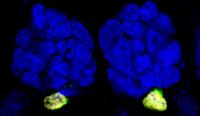
Carbon dioxide-sensitive neurons expressing Gr21a (green) and Gr63a (red), proteins that together (white) are necessary for carbon dioxide detection. The neurons target a specific region of the fly brain, which is dedicated to processing the smell of carbon dioxide.
Credit: Vosshall Laboratory Mosquitoes don’t mind morning breath. They use the carbon dioxide people exhale as a way to identify a potential food source. But when they bite, they can pass on a number of dangerous infectious diseases, such as malaria, yellow fever, and West Nile encephalitis. Now, reporting in today’s advance online publication in Nature, Leslie Vosshall’s laboratory at Rockefeller University has identified the two molecular receptors in fruit flies that help these insects detect carbon dioxide. The findings could prove to be important against the fight against global infectious disease.
| Full story | 0 Comments | 5371 views |
| Molecular & Cell Biology | December 13, 2006 09:14 PM |
WHAT: Botulism is a life-threatening disease caused by exposure to botulinum neurotoxins, which are among the most potent toxins known. These neurotoxins are produced by Clostridium botulinum, a bacterium found in soil and food. In the body, the toxins bind to and enter neurons, interfering with nerve transmission and disrupting the communication between the nerve and muscle fibers throughout the body. Poisoning with botulinum toxins leads to an often-fatal paralysis, which is one reason they are considered among the highest biodefense research priorities by the U.S. government.
| Full story | 0 Comments | 5715 views |

| Health & Medicine | December 13, 2006 08:14 PM |
The dyslexic brain struggles to read because even small distractions can throw it off, according to a new model of dyslexia emerging from a group of recent studies.
| Full story | 0 Comments | 6131 views |
| Molecular & Cell Biology | December 13, 2006 07:14 PM |
Give or take a few dozen trillions, a human adult has about 70 trillion cells. An adult Caenorhabditis elegans roundworm has exactly 959 cells.
| Full story | 0 Comments | 6102 views |

| AIDS & HIV | December 13, 2006 06:14 PM |
A University of Illinois at Chicago study has been stopped early due to preliminary results indicating that medical circumcision of men reduces their risk of acquiring HIV during heterosexual intercourse by 53 percent.
| Full story | 0 Comments | 6562 views |

| Stem Cell Research | December 13, 2006 05:14 PM |
Nothing in the cellular world is flat. Even the flattest of basement membranes has topography; bumps, if you like, beneath the cellular mattress.
| Full story | 0 Comments | 4370 views |
| Molecular & Cell Biology | December 13, 2006 04:14 PM |
Tumors start small and stay quiet, yet their intentions are clearly spelled out internally, if we could only read them. No matter how small, every tumor reveals its identity in tiny amounts of abnormally expressed proteins called oncoproteins. Being able to read trace oncoprotein levels from early-stage tumors would speak volumes to physicians and cancer researchers. Enter nano-fluidics and the art of reading a lot from very little.
| Full story | 0 Comments | 4350 views |
| Health & Medicine | December 13, 2006 02:30 PM |
Inflammatory breast cancer (IBC) is the deadliest form of the disease, with fewer than half of those diagnosed today having a five-year prognosis for survival. To find out what drives this most aggressive of human breast cancers, and to rapidly screen for drugs that might stop IBC, researchers at the University of California, San Diego (UCSD), have come up with an unlikely yet extremely promising ally: a transparent fish suitable for xenografts.
| Full story | 0 Comments | 3804 views |

| Biology | December 13, 2006 12:30 PM |
Waimanalo, HI – December 12, 2006 -- A new study in Journal of the World Aquaculture Society suggests that, while larger shrimp consistently win over smaller shrimp of the same gender when competing for food, male shrimp will almost always beat female shrimp – even though adult males of the species are typically much smaller than the adult females of the same age.
| Full story | 0 Comments | 5215 views |
| Molecular & Cell Biology | December 13, 2006 10:30 AM |
Scientists collaborating at Cornell University in Ithaca and Weill Cornell Medical College in New York City have identified a panel of 23 protein biomarkers in cerebrospinal fluid that acts as a neurochemical "fingerprint," which doctors might use someday to identify patients living with Alzheimer's disease.
| Full story | 0 Comments | 4858 views |

- In some genetic cases of microcephaly, stem cells fail to launch
- Yale team discovers how Zika virus causes fetal brain damage
- Scientists uncover the way a common cell enzyme alerts the body to invading bacteria
- Arctic gives clues on worst mass extinction of life
- Calcium channel blockers caught in the act at atomic level
Search Bio News Net
Free Biology Newsletter
- Flexibility That A.C.A. Lent to Work Force Is Threatened by...International Herald Tribune
- Bacteria Behind Legionnaires’ Disease Found at New York Police StationInternational Herald Tribune
- Prescription Price Crisis? 28 Million Americans See Spike in Drug...MSNBC.com: Health
- Seizing on Opioid Crisis, a Drug Maker Lobbies Hard for...International Herald Tribune
- Republicans are taking a big political risk on health careAP Health News
- Why We're So Divided Over Saving WolvesNational Geographic News