

Scientists at Karolinska Institutet in Sweden have helped to identify a molecule that can be used as a vaccination agent against growing cancer tumours. Although the results are so far based on animal experiments, they point to new methods of treating metastases.

| Biology | March 21, 2006 10:32 PM |
Choosing a mate is a big decision. And, at least for mice, it's one that is best made with input from one's peers.
| Full story | 0 Comments | 6339 views |

| Molecular & Cell Biology | March 21, 2006 09:32 PM |
Researchers at UC Santa Barbara have made a surprising discovery: phagocytosis depends more on particle shape than size. The research, which has far-reaching implications for immunology, vaccine development and drug delivery, is published today online in the Proceedings of the National Academy of Sciences by Samir Mitragotri, a UCSB professor of chemical engineering, and graduate student Julie A. Champion. The paper will be published in print on March 28.
| Full story | 0 Comments | 4771 views |

| Environment | March 21, 2006 08:32 PM |
The Amazon rainforest puts on its biggest growth spurt during the dry season, according to new research. The finding surprised the researchers.
| Full story | 0 Comments | 9366 views |

| Health & Medicine | March 21, 2006 07:32 PM |
A widely available drug may be effective in treating kidney disease, report scientists at the University of California, Santa Barbara. They describe the discovery in the online edition of the Proceedings of the National Academies of Science published the week of March 20.
| Full story | 0 Comments | 5573 views |
| Molecular & Cell Biology | March 21, 2006 06:32 PM |
A version of a gene previously linked to impulsive violence appears to weaken brain circuits that regulate impulses, emotional memory and thinking in humans, researchers at the National Institutes of Health's (NIH) National Institute of Mental Health (NIMH) have found. Brain scans revealed that people with this version – especially males – tended to have relatively smaller emotion-related brain structures, a hyperactive alarm center and under-active impulse control circuitry. The study identifies neural mechanisms by which this gene likely contributes to risk for violent and impulsive behavior through effects on the developing brain.
| Full story | 0 Comments | 6749 views |
| Biology | March 21, 2006 05:32 PM |
A group of scientists from Oregon have discovered that butterflies experience a great loss in body fat during metamorphosis. The details of their findings appear in the March issue of the Journal of Lipid Research, an American Society for Biochemistry and Molecular Biology journal.
| Full story | 0 Comments | 6307 views |
| Biology | March 21, 2006 04:05 PM |
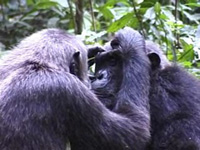
Photo credit: Simone PikaEditor: A video of the behavior is available! Check it out!
Humans commonly use referential gestures that direct the attention of recipients to particular aspects of the environment. Because the recipient of a referential gesture must infer the signaler's meaning, the use of these gestures has been linked with cognitive capacities such as the ability to recognize another individual's mental state. Researchers have now found evidence that such referential gesturing is a natural part of chimpanzee behavior.
| Full story | 0 Comments | 6845 views |
| Biology | March 21, 2006 02:05 PM |
Work reported this week provides new evidence that marsupials, like primates, have functional color vision based on three different types of color photoreceptor cones--but unlike primates, a component of marsupial color vision includes sensitivity to ultraviolet wavelengths.
| Full story | 0 Comments | 7472 views |
| Biology | March 21, 2006 12:05 PM |
Viruses are famous for evolving quickly, but the organisms they infect can't be expected to sit idly by. There is now new evidence that animals in fact do an impressive job of keeping up in the ongoing evolutionary arms race between viruses and their hosts. Studying a special class of genes thought to have evolved in part as a defense system against viruses, researchers have found evidence that these genes are indeed among the fastest-evolving in the genome of the fruit fly, Drosophila. The work is reported by University of Edinburgh researchers Dr. Darren Obbard and Dr. Tom Little and colleagues and appears in the March 21st issue of Current Biology.
| Full story | 0 Comments | 6484 views |

- In some genetic cases of microcephaly, stem cells fail to launch
- Yale team discovers how Zika virus causes fetal brain damage
- Scientists uncover the way a common cell enzyme alerts the body to invading bacteria
- Arctic gives clues on worst mass extinction of life
- Calcium channel blockers caught in the act at atomic level
Search Bio News Net
Free Biology Newsletter
- Flexibility That A.C.A. Lent to Work Force Is Threatened by...International Herald Tribune
- Bacteria Behind Legionnaires’ Disease Found at New York Police StationInternational Herald Tribune
- Prescription Price Crisis? 28 Million Americans See Spike in Drug...MSNBC.com: Health
- Seizing on Opioid Crisis, a Drug Maker Lobbies Hard for...International Herald Tribune
- Republicans are taking a big political risk on health careAP Health News
- Why We're So Divided Over Saving WolvesNational Geographic News