

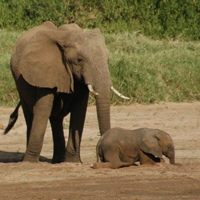
African elephants in Kenya's Samburu National Reserve. Credit: George WittemyerBy analyzing chemicals in tail hair from elephants that wore radio collars, researchers tracked the diet and movements of elephants in Kenya – a method aimed at reducing human-elephant conflicts and determining where to establish sanctuaries to protect the endangered creatures.

| Biology | January 2, 2006 10:25 PM |
| Full story | 0 Comments | 5591 views |

| Health & Medicine | January 2, 2006 08:26 PM |
Medical researchers at the University of Bonn, working in collaboration with scientists from Israel, the USA and Britain, have identified a previously unknown regulatory mechanism in the process of bone loss. Their findings could open up new approaches to the treatment of osteoporosis. More than four million people, predominantly women, are estimated to suffer from this distressing illness in Germany alone. In recognition of the importance of her results, Dr. Meliha Karsak from the Bonn-based Life & Brain Center has recently been awarded the Osteology Prize of the German Society for Endocrinology, which entails a cash award of 8,000 euros. Her study will now be published in the renowned "Proceedings of the National Academy of Sciences" (PNAS).
| Full story | 0 Comments | 9958 views |

| Molecular & Cell Biology | January 2, 2006 08:26 PM |
A new UCLA imaging study shows that age-related breakdown of myelin, the fatty insulation coating the brain's internal wiring, correlates strongly with the presence of a key genetic risk factor for Alzheimer disease.
| Full story | 0 Comments | 4906 views |
| Biology | January 2, 2006 08:25 PM |
Researchers have developed a new tool to help them study endangered whales – autonomous hydrophones that can be deployed in the ocean to record the unique clicks, pulses and calls of different whale species.
| Full story | 0 Comments | 5515 views |
| Biology | January 2, 2006 08:25 PM |
Why whales emit their characteristic calls remains largely a biological mystery, but listening for the distinctive underwater sounds provides a valuable way to track the movements of endangered large whales. Autonomous data-recording devices equipped with hydrophones (underwater microphones), deployed in remote waters off Alaska, have been used in recent years to track seasonal occurrences of blue, fin, humpback, North Pacific right, bowhead, and sperm whales, an article in the January 2006 issue of BioScience reports.
| Full story | 0 Comments | 6455 views |

- In some genetic cases of microcephaly, stem cells fail to launch
- Yale team discovers how Zika virus causes fetal brain damage
- Scientists uncover the way a common cell enzyme alerts the body to invading bacteria
- Arctic gives clues on worst mass extinction of life
- Calcium channel blockers caught in the act at atomic level
Search Bio News Net
Free Biology Newsletter
- Flexibility That A.C.A. Lent to Work Force Is Threatened by...International Herald Tribune
- Bacteria Behind Legionnaires’ Disease Found at New York Police StationInternational Herald Tribune
- Prescription Price Crisis? 28 Million Americans See Spike in Drug...MSNBC.com: Health
- Seizing on Opioid Crisis, a Drug Maker Lobbies Hard for...International Herald Tribune
- Republicans are taking a big political risk on health careAP Health News
- Why We're So Divided Over Saving WolvesNational Geographic News