General
GeneralAugust 31, 2005 11:07 PM

Thanks to the Katrina hurricane, we had a couple of thunderstorms here yesterday (even if we're far, far away north from where it happened, it always produce interesting climatic 'side effects' up here) which seem to have knocked out my cable modem, so I couldn't post news until... now. I condensed only the best from today and yesterday (~ 20 posts in a day would have been a bit much), so enjoy!

- Millions of bacterial species revealed underfoot
- Scientists probe anti-ageing gene
- Researchers Find That Carbon Dioxide Does Not Boost Forest Growth
- Apes 'extinct in a generation'
- Coral 'little damaged by tsunami'
- First convincing chimp fossil discovered
- Parasites brainwash grasshoppers into death dive

0 Comments 2389 views
Biology

5cheetah2_resize.jpg
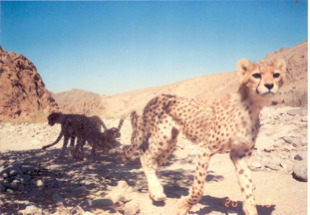
A family of five Asiatic cheetahs (four cubs and their mother) photographed by a remote camera trap in Iran's Dar-e Anjir Wildlife Refuge. The New York-based Wildlife Conservation Society and Iran's Department of Environment are collaborating on a conservation project in this region to safegurd the remaining population of these extremely rare cats. I.R.Iran DOE/CACP/WCS/ UNDP-GEF
Wildlife Conservation Society (WCS) scientists, working in conjunction with Iran’s Department of Environment (DOE) in an isolated region in the Dar-e Anjir Wildlife Refuge, recently discovered that a remote camera set out to survey wildlife had photographed an entire family of extremely rare Asiatic cheetahs. The pictures show an adult female and her four youngsters resting in the shade of a tree, marking the largest-known group of these rare cats ever photographed in Asia.

Bioinformatics

A study comparing the genomes of both humans and chimpanzees has found that much of the genetic difference between the two species came about in events called segmental duplications, in which segments of genetic code are copied many times in the genome. The study appears as a companion article to the draft sequence of the chimpanzee genome published in the Sept. 1 issue of the journal Nature.

Biotechnology

Results showed that the microbes in about a half a liter of rumen fluid - fermented, liquefied feed extracted from the rumen, the largest chamber of a cow's stomach - produced about 600 millivolts of electricity. That's about half the voltage needed to run one rechargeable AA-sized battery, said Ann Christy, a study co-author and an associate professor of food, agricultural and biological engineering at Ohio State University.

Environment

esa083005_1sm.jpg
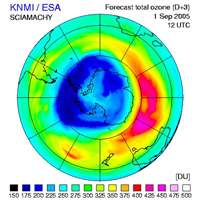
Ozone forecast for 1 September
This season's Antarctic ozone hole has swollen to an area of ten million square kilometres from mid-August - approximately the same size as Europe and still expanding. It is expected to reach maximum extent during September, and ESA satellites are vital for monitoring its development.

Biology

Experts call for $30 million action plan to save mankind's closest relatives

A combination of natural and man-made threats is killing gorillas and chimpanzees in Central Africa, and experts say $30 million is needed for special programs to save some of mankind's closest relatives from disappearing.

Biotechnology

Altered protein could help deliver drugs and shape the growth of engineered tissueCollagen often pops up in beauty products and supermodel lips. But by mating collagen with a molecular hitchhiker, materials scientists at Johns Hopkins hope to create some important medical advances. The researchers have found a simple new way to modify collagen, paving the way for better infection-fighting bandages and a treatment to block the formation of unwanted scar tissue. In addition, tissue engineers may be able to use modified collagen in the lab to help control the formation of tiny new blood vessels that can be used to promote the integration of tissue implants in patients.

Microbiology

An unusual type of antibiotic being developed by chemists at Notre Dame University shows promise in defeating deadly "superbugs" - highly drug-resistant staph bacteria that are an increasing source of hospital-based infections. The novel antibiotics, which could some day save lives, were described today at the 230th national meeting of the American Chemical Society, the world's largest scientific society.

Biology

Though humans may never match the tracking ability of dogs, we apparently have the ability to sniff out and locate odors, according to a new study by scientists from the University of California, Berkeley.

Molecular & Cell Biology

A group of Montreal researchers has discovered that GCN2, a protein in cells that inhibits the conversion of new information into long-term memory, may be a master regulator of the switch from short-term to long-term memory. Their paper Translational control of hippocampal synaptic plasticity and memory by the eIF2a kinase GCN2, which was published in the August 25th issue of the journal Nature, provides the first genetic evidence that protein synthesis is critical for the regulation of memory formation.

Health & Medicine

Severely restricting calories over decades may add a few years to a human life span, but will not enable humans to live to 125 and beyond, as many have speculated, evolutionary biologists report.

Biotechnology

Chicken-produced antibodies demonstrate enhanced cell killing compared to conventionally produced anti-cancer antibodies

Origen Therapeutics today announced the first published scientific report of fully functional, human sequence monoclonal antibodies (mAbs) produced in chickens. The antibodies were expressed solely in the chicken oviduct and deposited into egg white in concentrations of 1-3 milligrams per egg. Moreover, antibodies produced in this manner demonstrated 10-100 fold greater cell-killing ability (ADCC) compared to therapeutic antibodies produced by conventional cell culture methods.

Microbiology

A method for identifying Bacillus anthracis, the causative agent of anthrax, has been cleared for diagnostic use by the U.S. Food and Drug Administration (FDA). The test, known as the Gamma Phage Assay, was modified by scientists at the U.S. Army Medical Research Institute of Infectious Diseases (USAMRIID) to improve its performance and reliability when used with clinical specimens. The original form of the Gamma Phage Assay was first developed by the Centers for Disease Control and Prevention (CDC) in the mid-1950s.

Biotechnology

Biochemical technique expected to yield new, more effective test for disease-causing prions in cattle and humans

Researchers at the University of Texas Medical Branch at Galveston (UTMB) have found a way to detect in blood the malformed proteins that cause "mad cow disease," the first time such "prions" have been detected biochemically in blood.

Microbiology

Results reported at American Chemical Society meetingA chemical catalyst developed at Carnegie Mellon University completely destroys dangerous nitrophenols in laboratory tests, according to Arani Chanda, a doctoral student who is presenting his findings on Sunday, Aug. 28, at the 230th meeting of the American Chemical Society (ACS) in Washington, D.C. (Division of Industrial and Engineering Chemistry, Convention Center Hall A).

Molecular & Cell Biology

Montreal researchers identify new anti-cancer, anti-infection response control mechanism

Dr. André Veillette, a researcher at the Institut de recherches cliniques de Montréal (IRCM), and his team will publish in the upcoming issue of the prestigious journal Nature Immunology of Nature Publishing Group, a discovery that could significantly advance the treatment of cancers and infectious diseases. Current treatments frequently achieve only limited results with these types of diseases, which affect hundreds of thousands of Canadians.

Biotechnology

DNA isn't just for storing genetic codes any more. Since DNA can polymerize -- linking many molecules together into larger structures -- scientists have been using it as a nanoscale building material, constructing geometric shapes and even working mechanical devices.

Health & Medicine

Chemistry and biology researchers at Virginia Tech have enhanced the abilities of the molecules they are creating to deliver killing blows to cancer cells. The man-made molecular complexes enter cancer cells and, when signaled, deliver killing medicine or cause the cell to change. The new supermolecules have more units that will absorb light - providing more control over the range of light frequencies that can be included and excluded as signals and the responses.

Molecular & Cell Biology

It's no secret that George Bush the Elder doesn't like broccoli. That he's not alone is no surprise. But the range of foods that many people won't eat because they are sensitive to "bitter" taste, or, in the case of non-sugar sweeteners, an "unacceptable aftertaste," is longer than you might think. These include spinach, lettuce and for some, even citrus fruits and juices.

Health & Medicine

Loyola first in U.S. to implant new FDA-approved device

In a major advance for heart patients, Loyola University Health System is the first hospital in the U.S. to implant into a patient a new FDA-approved defibrillator which automatically signals the doctor via wireless satellite transmission if the patient's heart beats abnormally or if the device malfunctions, e.g., battery failure.

Molecular & Cell Biology

uoo-uoos082605.jpg
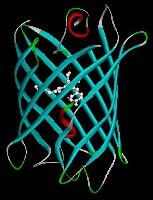
Schematic diagram of the protein structure surrounding the molecular segment responsible for light emission in the cyan fluorescent protein amFP486. Schematic diagram by Jim Remington, UO Institute of Molecular Biology
Discovery may lead to promising new research tools

University of Oregon scientists report their discovery of the basis for the blue coloration found in many coral reef formations in an article published this week by the Proceedings of the National Academy of Sciences.

Health & Medicine

Coffee provides more than just a morning jolt; that steaming cup of java is also the number one source of antioxidants in the U.S. diet, according to a new study by researchers at the University of Scranton (Pa.). Their study was described today at the 230th national meeting of the American Chemical Society, the world's largest scientific society.

Biotechnology

Research teams at Nihon Nohyaku Co., Ltd., Bayer CropScience and DuPont have developed two new classes of broad-spectrum insecticides that show promise as a safer and more effective way to fight pest insects that damage food crops. The insecticides, which represent the first synthetic compounds designed to activate a novel insecticide target called the ryanodine receptor, may also help tackle the growing problem of insecticide resistance, the researchers say. They described their studies today at the 230th national meeting of the American Chemical Society, the world’s largest scientific society.

Biology

How germ cells decide whether to be sperm or eggs

Johns Hopkins biologists have determined how developing embryos tell their specialized "germ cells" whether to develop into a male's sperm or a female's eggs.

Bioinformatics

Don't call them the Dirt Doctors, or Sultans of Soil, they're just clever Lab guys. A team from Los Alamos National Laboratory has a paper in this week's Science Magazine with a new way to count bugs in dirt. Bacteria, that is, in the highly complex world beneath our feet.

Molecular & Cell Biology

Investigators at the Jane and Terry Semel Institute for Neuroscience and Human Behavior at UCLA examining responses to cocaine and methamphetamine use find distinct differences in onset, pattern and duration.

Microbiology

Researchers at Duke University Medical Center have identified a previously unknown family of virulence factors that make the bacterium responsible for the plague especially efficient at killing its host.

Molecular & Cell Biology

Chemists at Ohio State University have gained new insight into how sunlight affects DNA. And what they found overturns ideas about genetic mutation that originated decades ago.

Health & Medicine

Max Planck researchers uncover the mechanism by which the new genetically engineered vaccine functionsThe vaccine has been licensed to the Vakzine Projekt Management who will test it in clinical trials early 2006. The responsible mechanisms for the high efficacy of this vaccine has now been deciphered (Journal of Clinical Investigations, August 18, 2005).

Health & Medicine

A drug first used to reduce the risk of stomach ulcers in people taking certain types of painkillers offers an alternative to surgery after miscarriage, according to a study by researchers at the National Institute of Child Health and Human Development of the National Institutes of Health and other research institutions.

The study appears in the August 18, 2005, New England Journal of Medicine.

Health & Medicine

Current methods to curb the epidemic of sleeping sickness in eastern Uganda are failing, concludes a Research Letterin this week’s issue of The Lancet.

AIDS & HIV

New phage display technique successful in identifying compounds that show potential to overcome drug resistance

A simple, harmless virus might hold the key to the more effective and efficient development of HIV and anti-viral drugs, UCI chemical biologists have found.

Microbiology

A well-respected researcher who is now a chief of an immunology laboratory of the National Institutes of Health (NIH) has rocked the boat in the past few years for the experts in the understanding of the autoimmune system.

Health & Medicine

A special stretch of genetic material may turn off the immune suppression that stymies attempts to fight cancer with a vaccine, said researchers at Baylor College of Medicine (BCM) at Houston.

Health & Medicine

PGC-1 mediates effects of nutrition on blood disease porphyria

Dana-Farber Cancer Institute researchers say they have uncovered a molecular explanation for the episodic attacks of irrational and demented behavior in porphyria, the disease believed to have afflicted "Mad" King George III, the British ruler blamed for the loss of the American colonies in the Revolutionary War.

Molecular & Cell Biology

A newly discovered protein not only is vital to the immune system's ability to fight off viral infections but also has been found in an unexpected location within the cell, causing researchers to rethink previous notions about the workings of the human immune system.

Health & Medicine

One of the most devastating diseases in sub-Saharan Africa almost disappeared in the late 1950s. That disease, African sleeping sickness, or trypanosomiasis, largely succumbed to heroic public health efforts -- including relocating entire villages. But in the past several decades, because of post-colonial turmoil, the catastrophic illness has come back to ravage parts of Angola, the Democratic Republic of the Congo, the Sudan and other countries. In some regions, the tsetse fly-borne infection rivals or exceeds the toll AIDS takes.

Microbiology

The malaria parasite Plasmodium falciparum uses different pathways to invade red blood cells, evading the body's immune system and complicating efforts to create effective vaccines against the disease. A research team led by Australia's Alan F. Cowman, an international research scholar with the Howard Hughes Medical Institute, has identified a gene that the parasite uses to switch back and forth between invasion pathways.

Molecular & Cell Biology

Researchers at UT Southwestern Medical Center have discovered that a protein prolonging life in mice works by controlling insulin.

Molecular & Cell Biology

New understanding of spinocerebellar ataxiaResearchers have discovered how the abnormal repetition of a genetic sequence can have disastrous consequences that lead to the death of neurons that govern balance and motor coordination. The studies bolster the emerging theory that neurodegenerative disorders can be caused by having extra copies of a normal protein, not just a mutated one.


Search Bio News Net


Free Biology Newsletter