

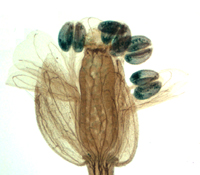
Successful Trap of a Pollen-Specific GeneIdentifying genes based on patterns of gene expression in specific organs or at specific stages of development is a useful approach to improving our understanding of complex biological processes. Scientists Vivian Irish at Yale University in Connecticut, Rob Martienssen at Cold Spring Harbor Laboratory in New York, and their colleagues used a strategy known as "gene trapping" to identify numerous genes involved in the regulation of flower development in the model plant Arabidopsis thaliana.

| Biotechnology | July 31, 2005 05:36 PM |
| Full story | 0 Comments | 13083 views |

| Biology | July 31, 2005 05:34 PM |

Credits: ESAA colourful summer marine phytoplankton bloom fills much of the Baltic Sea in this Envisat image.
Phytoplankton are microscopic marine plants that drift on or near the surface of the sea, by far the most abundant type of life found in the ocean. Just like plants on land they employ green-pigmented chlorophyll for photosynthesis - the process of turning sunlight into chemical energy. While individually microscopic, phytoplankton chlorophyll collectively tints the surrounding ocean waters, providing a means of detecting these tiny organisms from space with dedicated 'ocean colour' sensors.
| Full story | 2 Comments | 33956 views |

| Health & Medicine | July 31, 2005 05:33 PM |
A University of Cincinnati (UC) study provides new evidence that drinking large amounts of beverages containing fructose adds body fat, and might explain why sweetening with fructose could be even worse than using other sweeteners.
| Full story | 0 Comments | 8427 views |
| Biology | July 31, 2005 05:27 PM |
A historic expedition of Census of Marine Life explorers to the planet's most northern reaches has revealed a surprising density and diversity of Arctic Ocean creatures, some believed new to science.
| Full story | 0 Comments | 6189 views |
| Health & Medicine | July 31, 2005 05:26 PM |
Mayo Clinic researchers have found that the cause of chronic sinus infections lies in the nasal mucus -- the snot -- not in the nasal and sinus tissue targeted by standard treatment. The findings will be published in the August issue of Journal of Allergy and Clinical Immunology and are available online.
| Full story | 0 Comments | 10029 views |
| Health & Medicine | July 31, 2005 05:23 PM |
Fears that chemical byproducts resulting from purifying drinking water with chlorine boost the chances that pregnant women will miscarry were not supported by the results of a major new study. If such threats exist at all, which is uncertain, they likely are modest, it concludes.
| Full story | 0 Comments | 6226 views |

| AIDS & HIV | July 31, 2005 05:18 PM |
Two new studies support the hypothesis that combination antiretroviral drug therapy may reduce the risk of mother-to-child HIV transmission through breastfeeding, findings that could have significant implications in the developing world.
| Full story | 0 Comments | 8301 views |

| Molecular & Cell Biology | July 31, 2005 05:17 PM |
From birth until death, our cells migrate: nerve cells make their vital connections, embryonic cells move to the proper places to form organs, immune cells zero in to destroy pathogenic organisms, and cancer cells metastasize, spreading deadly disease through the body. Scientists studying these migrations didn't know how cells determined where to go. Until now.
| Full story | 0 Comments | 6210 views |
| Biotechnology | July 31, 2005 05:15 PM |
A new technique aimed at directly controlling the expression of genes by turning them on or off at the DNA level could lead to drugs for the treatment or cure of many diseases, say researchers at UT Southwestern Medical Center.
| Full story | 0 Comments | 5556 views |
| Molecular & Cell Biology | July 31, 2005 05:13 PM |
Duke University Medical Center researchers have discovered a new mechanism by which chronically high levels of the neurotransmitter dopamine exert their effects on the brain. Normally associated with triggering feelings of pleasure, excess concentrations of dopamine underlie schizophrenia, attention deficit hyperactivity disorder and other psychiatric conditions. The findings therefore provide new research avenues to understand and potentially manage such dopamine-related human disorders, the researchers said.
| Full story | 0 Comments | 7116 views |
| Molecular & Cell Biology | July 31, 2005 05:09 PM |
Brown University biologists have solved the structure of a critical piece of synapse-associated protein 97 (SAP97) found in abundance in the heart and head, where it is believed to play a role in everything from cardiac contractions to memory creation. Results are published in The Journal of Biological Chemistry.
| Full story | 0 Comments | 5623 views |
| Biology | July 29, 2005 07:38 PM |
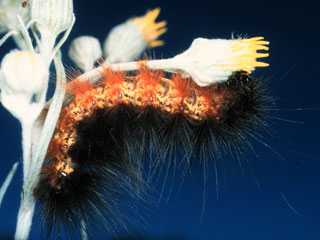
A tiger moth caterpillar feeding on a ragwort plant, which contains toxins that are especially tasty to parasitized caterpillars. Photo: Michael Singer/NATURESome parasites trigger their own destruction by altering their hosts' behavior, researchers at The University of Arizona and Wesleyan University report in Nature. Many parasites have developed mechanisms that suppress their hosts' ability to fight them off or even change their behavior in favor of the parasite. "We found the opposite is true with tiger moth caterpillars and their parasites," said UA Regents' Professor Emerita Elizabeth Bernays.
| Full story | 0 Comments | 10191 views |
| Biology | July 29, 2005 07:35 PM |
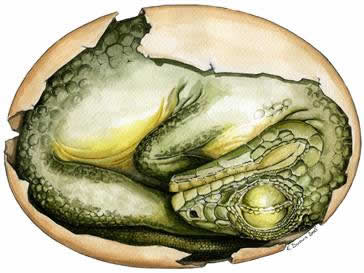
An artist's reconstruction shows a curled-up dinosaur embryo inside an egg. The actual egg is a little more than 2 inches (6 centimeters) in length. Image: Kevin Dupuis, University of Toronto at MississaugaThe embryos of a long-necked, herbivorous dinosaur are the earliest ever recorded for any terrestrial vertebrate and point to how primitive dinosaurs evolved into the largest animals ever to walk on earth, say scientists from the University of Toronto at Mississauga (UTM), the Smithsonian Institution and the University of Witwatersrand, South Africa.
| Full story | 0 Comments | 12243 views |
| Biology | July 29, 2005 07:33 PM |
What do hot sauce aficionados and African elephants have in common? They both feel the burn of chilli peppers, the key ingredient for resolving human-elephant conflicts in Africa while raising money for farmers and conservation.
| Full story | 0 Comments | 6393 views |

| Microbiology | July 29, 2005 07:32 PM |
A collaborative research team from the Uniformed Services University of the Health Sciences (USU), the Australian Animal Health Laboratory (AAHL) and the National Cancer Institute (NCI) have made a major breakthrough in efforts to combat two deadly viruses that could be engineered for use as bioweapons. The team isolated the functional receptor for the Nipah and Hendra viruses--naturally occurring and highly pathogenic paramyxoviruses for which no treatments or vaccines are currently available.
| Full story | 0 Comments | 6226 views |
| Microbiology | July 29, 2005 07:30 PM |
Scientists at Harvard Medical School (HMS) have revealed details of a key step in the entry of anthrax toxin into human cells. The work, which grew out of an ongoing effort to produce a better anthrax therapeutic, shows that the protective antigen component of the bacterial toxin plays an active role in transferring the other two components of the toxin through the cell membrane.
| Full story | 0 Comments | 5845 views |
| Microbiology | July 29, 2005 07:29 PM |
By determining the molecular structure of a protein that enables malaria parasites to invade red blood cells, researchers have uncovered valuable clues for rational antimalarial drug design and vaccine development. The findings are reported in the July 29 issue of the journal Cell.
| Full story | 0 Comments | 6127 views |
| Microbiology | July 29, 2005 07:27 PM |
Two studies by researchers at the University of Chicago show how the bacteria that cause the plague manage to outsmart the immune system and how, by slightly altering one of the microbe's tools, the researchers produced what may be the first safe and effective vaccine.
| Full story | 0 Comments | 6699 views |
| Microbiology | July 29, 2005 07:26 PM |
The human opportunistic pathogen, Pseudomonas aeruginosa, has broken the immune system's code, report researchers from the University of Chicago, enabling the bacteria to recognize when its host is most vulnerable and to launch an attack before the weakened host can muster its defenses.
| Full story | 0 Comments | 8717 views |
| AIDS & HIV | July 29, 2005 07:20 PM |
Random fluctuations in gene expression can influence the fates of cells infected with human immunodeficiency virus (HIV) far more than previously thought, according to new research from Howard Hughes Medical Institute (HHMI) researchers at the University of California, Berkeley. By combining experimental and computational studies of HIV's replication cycle, the researchers found evidence that the virus may become latent in some cells by harnessing the random molecular behavior of the cell.
| Full story | 2 Comments | 8310 views |
| Biology | July 29, 2005 07:09 PM |
A new study released in Science (via Science Express http://www.sciencexpress.org) on July 28th reveals a striking downward trend in the diversity of fish in the open ocean – the largest and least known part of our planet. Teasing apart the effects of climate change and fishing over the past 50 years, the authors show a clear link to overfishing and highlight a surprising global pattern of open ocean hotspots - areas with predictable congregations of tuna, marlin, swordfish, and other ocean predators.
| Full story | 0 Comments | 7184 views |
| Biology | July 28, 2005 06:54 PM |
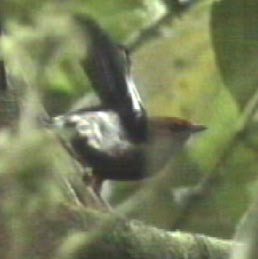
A male club-winged manakin - Courtesy of Kimberly BostwickHummingbirds and rattlesnakes move parts of their bodies at amazing speeds. But male club-winged manakins -- colorful, sparrow-sized South American birds -- have them both beat, vibrating their wings at more than 100 cycles per second, twice the speed of hummingbirds. The bird uses this unprecedented feat not for fight or flight, but to impress females with its violinlike hum.
| Full story | 0 Comments | 11697 views |
| Biotechnology | July 28, 2005 06:52 PM |
Imagine a cancer drug that can burrow into a tumor, seal the exits and detonate a lethal dose of anti-cancer toxins, all while leaving healthy cells unscathed.
MIT researchers have designed a nanoparticle to do just that.
| Full story | 0 Comments | 6788 views |

| Stem Cell Research | July 28, 2005 06:51 PM |
Previously unrecognized stem cells found in the bone marrow and blood of mice can "restock" a depleted ovary with new egg cells within weeks, according to new research published in this week's issue of the journal Cell.
| Full story | 0 Comments | 8922 views |
| Health & Medicine | July 28, 2005 06:50 PM |
Effective control of sexually transmitted diseases (STDs) requires treatment of the sexual partners of infected patients. A new study shows that providing infected men with antibiotics to give their partners is more effective than traditional means of contacting and treating the partners, according to an article in the Sept. 1 issue of Clinical Infectious Diseases, now available online. Men with chlamydia or gonorrhea were more likely to see and talk to their female partners about the STD when given medicine to give to their partners than the men who were simply told to inform their partners of their STD exposure.
| Full story | 0 Comments | 7231 views |
| Health & Medicine | July 28, 2005 06:48 PM |
In cancer research, biomarkers are molecules that indicate the presence of cancer in the body. Most are based on abnormal changes or mutations in genes, RNA, proteins and metabolites. Since the molecular changes that occur during tumor development can take place over a number of years, biomarkers potentially can be used to detect cancers early, determine prognosis and monitor disease progression and therapeutic response. Candidate biomarkers, however, frequently are found only in relatively low concentrations amid a sea of other biomolecules, so both biomarker research and possible diagnostic tests depend critically on the ability to make highly sensitive and accurate biochemical measurements.
| Full story | 0 Comments | 6115 views |
| Stem Cell Research | July 28, 2005 05:48 PM |
The finding has led to the development of a new chemical compound that can accelerate this process (called stem cell mobilization) in mice--which could eventually lead to more efficient stem cell harvesting for human use.
| Full story | 0 Comments | 7985 views |
| Stem Cell Research | July 28, 2005 05:46 PM |
Circulating stem cells play a minor role in repairing lung damage, according to a team of scientists who used male and female chromosomal differences to analyze the repair process in lung transplant patients.
| Full story | 0 Comments | 8232 views |

| Bioinformatics | July 28, 2005 05:45 PM |
The National Research Council Biotechnology Research Institute (NRC-BRI) today announced the publication of an article that reveals the complete genomic annotation of Candida albicans, a fungal pathogen that is one of the main causes of infection in people with weakened immune systems, and currently very difficult to treat.
| Full story | 0 Comments | 8143 views |

| Environment | July 28, 2005 05:43 PM |
The rivers of South America's Amazon basin are "breathing" far harder – cycling the greenhouse gas carbon dioxide more quickly – than anyone realized.
Most of the carbon being exhaled – or outgassed – as carbon dioxide from Amazonian rivers and wetlands has spent a mere 5 years sequestered in the trees, other plants and soils of the surrounding landscape, U.S. and Brazilian researchers report in the July 28 issue of Nature.
| Full story | 0 Comments | 7291 views |
| Biology | July 28, 2005 05:41 PM |
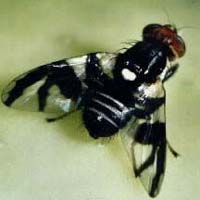
Ragoletis fruit fly. The animal family tree may not be filled just with forks, but may also contain knots: hybrid species with two different ancestors rather than one, according to a team of Penn State researchers.
"We are looking for the origin of species," says Dr. Dietmar Schwarz, post-doctoral researcher in entomology. "In animals, people envision the formation of a new species by a split of one ancestral species to two derived species or a branching of one species from another."
However, according to Schwarz, another way to get a new species is for two species to hybridize – mate with each other – forming a new species lineage while the parental species persists.
| Full story | 0 Comments | 9825 views |
| AIDS & HIV | July 28, 2005 05:28 PM |
Data presented at IAS build a compelling case for FUZEON (enfuvirtide, formerly known as T-20) to be combined with the newest drugs to give patients facing resistance their best chance of achieving undetectable viral load – the optimal treatment goal for all people living with HIV.
| Full story | 0 Comments | 7537 views |
| Health & Medicine | July 28, 2005 05:26 PM |
Scientists at the MUHC have made progress in understanding what causes migraines. The research, published in the new issue of the Proceedings of National Academy of Sciences (PNAS), reveals how gene mutations known to cause a form of inherited migraine--the kind that cause debilitating headaches and light flashes known as auras--target a cellular process involved in brain cell communication.
| Full story | 0 Comments | 7767 views |
| Biology | July 27, 2005 05:55 PM |
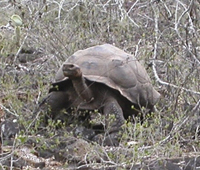
Unnamed taxon of Galapagos Tortoise Almost 150 years after Charles Darwin proposed a mechanism for biological evolution, previously unrecognized diversity has been discovered among the giant tortoises of the Galápagos, Geochelone nigra, whose distinctiveness was an inspiration in formulating the theory of natural selection.
| Full story | 0 Comments | 10600 views |
| Stem Cell Research | July 27, 2005 05:54 PM |
Final results of a study conducted at Johns Hopkins show that stem cell therapy can be used effectively to treat heart attacks, or myocardial infarction, in pigs. In just two months, stem cells harvested from another pig's bone marrow and injected into the animal's damaged heart restored heart function and repaired damaged heart muscle by 50 percent to 75 percent.
| Full story | 0 Comments | 8704 views |

| Gene Therapy | July 27, 2005 05:53 PM |
Combining partially differentiated stem cells with gene therapy can promote the growth of new "insulation" around nerve fibers in the damaged spinal cords of rats, a new study shows. The treatment, which mimics the activity of two nerve growth factors, also improves the animals' motor function and electrical conduction from the brain to the leg muscles. The finding may eventually lead to new ways of treating spinal cord injury in humans. The study was funded in part by the National Institute of Neurological Disorders and Stroke (NINDS), part of the National Institutes of Health.
| Full story | 0 Comments | 10065 views |
| Bioinformatics | July 27, 2005 05:52 PM |
An innovative new statistical method, described in the open-access journal PLoS Biology, streamlines the computation required to identify all the potential locations in the genome that influence a particular physical trait, or phenotype. Thanks to the new method developed by John Storey, Joshua M. Akey, and Leonid Kruglyak, researchers have a more efficient genome-mining technique to help them identify all the genomic elements that produce specific traits.
| Full story | 0 Comments | 6479 views |
| Molecular & Cell Biology | July 27, 2005 05:50 PM |
Researchers at the University of Illinois at Chicago have identified an elusive subunit of a neurotransmitter receptor found in both humans and the much-studied laboratory nematode C. elegans which may open new pathways of research on muscle function.
| Full story | 0 Comments | 6253 views |
| Stem Cell Research | July 27, 2005 05:48 PM |
Johns Hopkins researchers have discovered that a single protein regulates secretion levels in the fruit fly's salivary gland and its skin-like outer layer.
Described in the May 15 issue of Development, the finding improves understanding of how cells become specialized for secretion, which is a critical ability of certain glands and cell types in organisms from insects to humans.
| Full story | 0 Comments | 6799 views |
| Health & Medicine | July 27, 2005 05:48 PM |
A re-examination of data from earlier studies suggests that exposure to second-hand smoke during pregnancy can be just as detrimental to a developing fetus as primary exposure through maternal smoking, according to a recent paper from the University of Pittsburgh Graduate School of Public Health.
| Full story | 0 Comments | 7069 views |

- In some genetic cases of microcephaly, stem cells fail to launch
- Yale team discovers how Zika virus causes fetal brain damage
- Scientists uncover the way a common cell enzyme alerts the body to invading bacteria
- Arctic gives clues on worst mass extinction of life
- Calcium channel blockers caught in the act at atomic level
Search Bio News Net
Free Biology Newsletter
- Flexibility That A.C.A. Lent to Work Force Is Threatened by...International Herald Tribune
- Bacteria Behind Legionnaires’ Disease Found at New York Police StationInternational Herald Tribune
- Prescription Price Crisis? 28 Million Americans See Spike in Drug...MSNBC.com: Health
- Seizing on Opioid Crisis, a Drug Maker Lobbies Hard for...International Herald Tribune
- Republicans are taking a big political risk on health careAP Health News
- Why We're So Divided Over Saving WolvesNational Geographic News